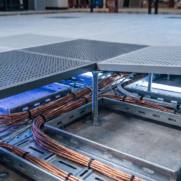
Data centers rely on efficient cooling systems to keep servers up and running, and perforated flooring is often part of those systems. However, not all perforated floor panels are the same. Materials, hole patterns, and panel specifications all affect how the panel manages airflow, supports heavy equipment, and helps prevent unexpected downtime. Here’s what to consider when specifying perforated flooring for data centers.
What Should You Consider When Specifying Perforated Flooring for Data Centers?
Airflow requirements, open area percentage, load capacity, material thickness, and perforation patterns should all be considered when specifying perforated floor panels. The right combination delivers cooling air to the server equipment and maintains structural integrity for reliable performance. Engineers should also consider raised floor compatibility, maintenance and access, and operating conditions.
How Does Perforated Flooring Help Data Center Cooling?
Many data centers use raised access floors to circulate conditioned air through an underfloor plenum. Perforated panels allow that air to enter designated areas, particularly cold aisles where servers draw air into their cooling systems.
In our experience, when perforated flooring is properly designed, it works with the overall cooling design to:
- Improve cooling efficiency: Direct conditioned air toward the equipment that needs it.
- Manage hot spots: Support consistent cooling across high-density server environments.
- Reduce wasted airflow: Limit air delivery to areas without significant cooling demands.
- Support equipment reliability: Help maintain appropriate operating temperatures.
- Accommodate changing layouts: Allow facilities to adjust airflow distribution for evolving equipment configurations.
How Much Open Area Should Data Center Perforated Floor Panels Have?
It’s easy to think that a higher open area means better cooling. However, that’s not always the case. Airflow performance also depends on:
- Pressure differences between the underfloor plenum and the occupied space
- Hole diameter and perforation geometry
- Panel thickness and opening edge characteristics
- Airflow obstructions beneath the floor
- Damper settings and airflow control systems
Before selecting an open-area percentage, engineers should determine the required airflow in cubic feet per minute (CFM). For instance, a high-density server rack likely needs more cooling airflow than a rack housing lower-power equipment. That means that the floor panels serving those racks will need different airflow characteristics.
Our recommendation: treat the open-area percentage as one piece of the airflow specification instead of the benchmark for cooling performance.
Which Perforation Patterns Work Best for Data Center Flooring?
Perforation patterns directly affect airflow distribution, structural strength, and manufacturing requirements.
Round-Hole Perforations
With predictable geometry, manufacturing efficiency, and consistent opening distribution, round holes are a practical choice for ventilation and airflow management design. Engineers can adjust the hole diameter and spacing to meet specific open-area targets while preserving material between openings.
Staggered Perforation Patterns
Staggered patterns arrange the perforated openings in offset rows. This configuration distributes openings evenly across a panel to achieve relatively high open area percentages. However, the pattern also affects the amount and arrangement of metal that’s left between the holes, so engineers should consider whether or not the panel will still be strong enough for the intended load.
Straight-Row Perforation Patterns
Straight-row patterns align openings both horizontally and vertically. These configurations may work for some fabrication requirements, airflow designs, or structural constraints.
How Do You Determine the Right Load Capacity for Perforated Data Center Flooring?
Data centers house heavy server racks, power distribution equipment, battery systems, and other infrastructure. Perforated floor panels must support those loads without excessive deflection or structural failure.
When engineers specify perforated flooring, they should keep three loading conditions top of mind:
- Concentrated loads: Weight that’s applied to a relatively small area, like a rack foot or equipment caster.
- Uniform loads: Weight that’s distributed across a larger section of flooring.
- Rolling loads: Forces that equipment carts, pallet jacks, or other moving loads apply as they travel across the floor.
Keep in mind that a perforated panel that performs adequately under a stationary load may not perform as well when heavy equipment is repeatedly moved across its surface. That’s why engineers also need to consider the floor panel’s support structure, including pedestals, stringers, frames, and attachment methods.
What Metal Thickness and Materials Should You Specify for Perforated Flooring?
Choosing the best material for perforated data center flooring ultimately depends on the required load rating, panel construction, environmental conditions, and compatibility with the raised flooring system. However, we’ve found that engineers frequently choose steel and aluminum for their durability, weight, and corrosion resistance. While both materials are strong choices, don’t assume that they perform the same.
Steel Perforated Floor Panels
Steel’s strength and rigidity make it a practical choice for components that are subjected to demanding mechanical loads. Engineers can specify various thicknesses, grades, and protective finishes to meet the application’s demands.
Aluminum Perforated Floor Panels
Aluminum’s lower weight and natural corrosion resistance are beneficial in applications where handling and weight make a difference.
The thickness of the material also affects the panel’s performance. Thicker metal can improve a panel’s rigidity, but it also increases the weight and can affect the perforation geometry and airflow resistance.
How Do Static Control and Surface Finishes Affect Data Center Flooring?
Data center flooring needs to support mechanical performance and cooling efficiency, as well as control electrostatic discharge (ESD) around sensitive electronic equipment. To do that, engineers need to evaluate surface conductivity, grounding requirements, and compatibility with the facility’s ESD control strategy.
Depending on the application, protective coatings and surface treatments on perforated flooring panels can provide:
- Improved corrosion resistance
- Greater resistance to routine wear
- Easier cleaning and maintenance
- Compatibility with the facility’s electrical grounding requirements
However, a protective finish doesn’t automatically provide ESD protection. The complete flooring assembly must meet the project’s electrical performance requirements, not just the perforated panels.
What Information Should You Include in a Perforated Flooring Specification?
A detailed specification helps metal fabricators fully understand your project’s specific requirements. Before submitting an RFQ for custom perforated flooring components, gather your CAD drawings or detailed engineering prints, along with the following information.
- Panel dimensions: Identify overall length, width, thickness, and dimensional tolerances.
- Material requirements: Specify metal type, grade, and applicable material standards.
- Perforation geometry: Include hole shape, diameter, spacing, pattern, and target open area percentage.
- Airflow requirements: Provide the required CFM and design pressure differential, along with any applicable airflow testing criteria.
- Structural requirements: Identify concentrated, uniform, and rolling load requirements, along with allowable deflection.
- Support and mounting details: Include panel edge conditions, frame dimensions, fastening methods, and compatibility with the existing floor system.
- Surface finish: Describe corrosion protection, coating requirements, and any ESD-related specifications.
- Quantity and production schedule: Provide expected order volumes, delivery requirements, and project deadlines.
What Common Mistakes Should You Avoid When Specifying Data Center Floor Panels?
Even seemingly small specification errors can lead to significant problems during installation or operation. We’ve found these three mistakes to be the most common.
Prioritizing Open Area Over Structural Strength
Yes, increasing the number of perforations can improve airflow, but it also removes supporting material. Designers need to verify that the finished panel matches the required load capacity.
Ignoring Actual Airflow Conditions
A perforated panel’s open area percentage doesn’t tell engineers exactly how much air will pass through it. The actual airflow performance is determined by underfloor pressure, obstructions, and the overall cooling system. Be sure to use project-specific calculations and tested panel performance data.
Overlooking Manufacturing Tolerances
Data center flooring typically requires precise dimensions to fit existing support systems and maintain level walking surfaces. An incorrect hole placement, edge clearance, or overall dimension can complicate installation and compromise performance.
Find Custom Perforated Metal for Data Centers at Roy Manufacturing
Data center infrastructure calls for precision, consistency, and dependable performance. At Roy Manufacturing, we deliver accurate, custom perforated metal components to meet those demands for customers nationwide. Our Portland, Oregon-based team can work with your specifications to produce engineered flooring assemblies, ventilation panels, and equipment enclosures you can rely on. Contact us today for a same-day quote.
Frequently Asked Questions
What is the purpose of perforated flooring in a data center?
Perforated flooring helps distribute conditioned air from raised-floor cooling systems to server equipment. The openings allow cool air to enter designated areas, particularly cold aisles, where servers draw air into their cooling systems. This proper airflow distribution helps data centers manage equipment temperatures, reduce hot spots, and improve cooling efficiency.
What percentage of open area should data center perforated flooring have?
The ideal open area percentage depends on the facility’s cooling requirements, underfloor air pressure, and server density. Higher open-area percentages can increase airflow potential, but they can also reduce panel strength. Engineers should evaluate required airflow in cubic feet per minute (CFM), pressure differentials, and structural load requirements before selecting a perforation pattern.
What materials work best for perforated data center floor panels?
Steel and aluminum are two of the best options for perforated metal flooring components. Steel provides strength and rigidity for demanding applications, while aluminum offers a lighter weight and corrosion resistance. The best choice depends on the required load capacity, material thickness, environmental conditions, and compatibility with the raised flooring system.
How does perforation size affect data center cooling efficiency?
Perforation size affects open area, airflow resistance, and the floor panel’s structural strength. Larger or more closely spaced holes can increase available airflow openings, but the actual airflow also depends on pressure differences and panel geometry. Engineers must balance perforation size and spacing with cooling performance and load-bearing requirements.
How much weight can perforated data center flooring support?
Load capacity depends on the panel material, thickness, perforation pattern, support structure, and overall floor system design. Engineers should consider concentrated loads, uniformly distributed loads, and rolling loads from equipment movement. The raised-floor manufacturer or responsible engineer should verify that the complete flooring assembly meets the project’s structural requirements.