Roy Mfg Knowledge Base
What’s the difference between a component that performs exactly as it should vs. one that causes costly design or production problems? Often, it’s simply knowing how to specify perforated metal.
Hole size, centers, material gauge, open area, and sheet size all factor into how a perforated sheet looks, performs, and fits into your finished assembly. Keep reading as we explain how to provide your perforated metal manufacturer with the clear specs they need to produce the quality product you’re expecting.
What Information Do You Need To Specify Perforated Metal?
Perforated metal specs should identify the material type and thickness, hole size and shape, center-to-center spacing, perforation pattern, required open area, sheets or finished-part dimensions, and quantity. You should also include margins, blank areas, orientation, and any secondary fabrication requirements.
Why Do Specifications Matter?
A perforated sheet may look simple enough, but there are several variables that determine how it performs. For example, changing the diameter of a round hole without changing the centers can increase the open area, whereas moving the holes farther apart can reduce it. Increasing the material thickness can improve rigidity, but it can also affect which hole sizes and patterns can be produced efficiently.
That’s why we recommend that engineers, designers, and buyers consider all of the variables when they specify perforated metal. Thickness, metal type, width and length, perforation size and shape, arrangement, shaping, and margins work together in every perforated project.
How Do You Specify Perforated Metal Hole Size?
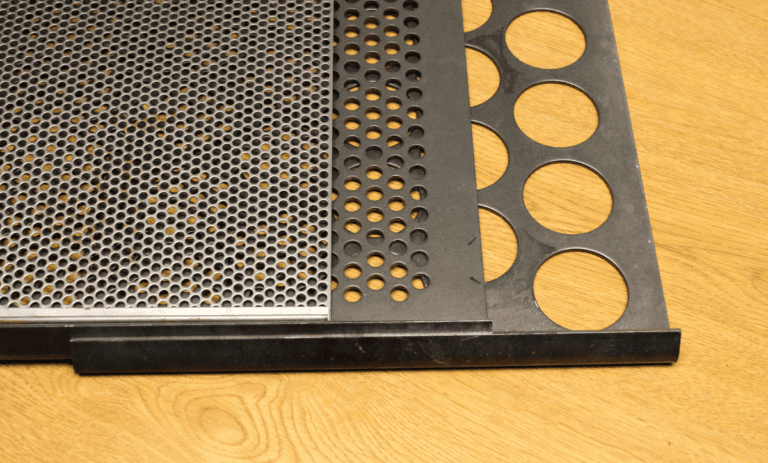
Hole size describes the dimensions of each opening in the sheet. For round perforations, you need to specify the hole diameter. For square holes, provide the width and height. For slotted holes, identify both the width and length, as well as the direction the slots should run.
The hole size affects several aspects of performance.
- Airflow and ventilation
- Light transmission
- Particle screening and filtration
- Visibility
- Sound transmission
- Panel strength
- Overall appearance
As you think about hole size for your project, keep in mind that a larger opening doesn’t always mean a better panel. Whether you need an industrial screen, architectural panel, or data center component, the right spec is the one that balances open area and structural integrity for your application.
What Are Centers in a Perforated Metal Specification?
When you specify centers in perforated metal, you’re describing the center-to-center distance between adjacent perforations. You may also hear this measurement called pitch. To properly measure centers, start at the center of one hole and measure to the center of the neighboring hole (not the solid metal bridge between openings).
For example, a specification may call for ¼-inch round holes on ⅜-inch staggered centers. Notice that there are two sets of numbers in there. Both of them are important. Simply requesting ¼-inch holes doesn’t provide the manufacturer with all of the information to reproduce your pattern.
Center spacing is also a factor in determining open area. Closer centers generally place more holes within a given area, while wider spacing leaves more solid material between the openings.
Should You Specify Straight or Staggered Centers?
When you specify perforated metal for your project, you need to identify how the holes should line up. Straight and staggered patterns are the most common arrangements, but Roy Manufacturing also produces custom patterns.
Your pattern selection affects your project’s appearance, open area, and the distribution of the remaining metal across the sheet. If pattern orientation is key to the finished assembly, be sure to include that information in your drawing or purchase specification.
How Do You Choose the Right Material Gauge?
Gauge is the number that tells you how thick a sheet of metal is. Choosing the right gauge always comes down to the material and what your finished component has to do. For example, a lightweight decorative panel has different structural demands than an industrial screen, equipment guard, or heavy-duty machinery component.
When choosing your material thickness, we recommend considering:
Required strength and rigidity
- Overall panel dimensions
- Hole diameter and spacing
- Open area percentage
- Mounting method
- Forming or bending requirements
- Operating environment
- Weight limitations
From a manufacturing standpoint, material thickness and hole size need to work together. Some combinations of thickness, hole dimensions, spacing, and pattern complexity may favor punching, while other custom details may benefit from laser cutting or another fabrication method.
What Does Open Area Mean in Perforated Metal?
Open area is the percentage of the sheet that’s occupied by openings rather than solid material. It’s a useful way to evaluate how much air, light, sound, liquid, or other material can pass through a perforated panel.
For example, two sheets with the same hole diameter may have different open-area percentages because they use different center spacing or patterns.
Open area is a top consideration in applications like:
- HVAC and ventilation
- Data center airflow
- Industrial filtration
- Screening and sorting
- Acoustic systems
- Architectural sunshades
- Equipment enclosures
Like hole size, more open area isn’t necessarily better. Yes, increasing it can improve airflow or visibility, but it can also affect the panel’s rigidity and protection. We recommend matching the open area to your component’s functional requirements.
How Do You Calculate Perforated Metal Open Area?
The calculation depends on the hole shape, dimensions, center spacing, and pattern. In our experience, it’s much better to calculate the percentage from the actual perforation spec rather than estimate it from appearance.
Our open area calculator lets customers enter their dimensions and select a pattern to easily calculate the open-area percentage. The tool also provides a preview so designers can visualize the proposed perforated sheet.
How Should You Specify Perforated Metal Sheet Size?
Always provide your manufacturer with the width and length of your required sheet or finished component. Industry ordering guidelines generally treat the length as the long dimension unless otherwise specified, but be sure to clearly identify both dimensions to help eliminate confusion.
Sheet size is especially important when the perforated material needs additional fabrication. Your drawing should account for:
- Unperforated margins
- Mounting holes
- Blank areas
- Bends and flanges
- Cutouts
- Weld locations
- Hardware clearances
- Finished-part dimensions
Don’t assume the perforations should extend from edge to edge. If your design needs solid borders or specific margins for fastening, forming, or welding, be sure to show them on the drawing.
What Should You Include in a Perforated Metal RFQ?
A clear RFQ is key to helping your manufacturer understand the product you need and how you intend to use it. Before requesting a quote, provide as many of the following specs as possible.
- Material: Mild steel, stainless steel, aluminum, or another metal
- Thickness: Gauge or decimal thickness
- Hole size: Diameter or opening dimensions
- Hole shape: Round, square, slotted, hexagonal, or custom
- Centers: Center-to-center spacing
- Pattern: Straight, staggered, or custom arrangement
- Open area: Required percentage for performance
- Sheet size: Width and length (or finished-part dimensions)
- Margins: Solid borders or unperforated areas
- Quantity: Number of sheets or finished components
- Secondary operations: Cutting, forming, deburring, finishing, rolling, drilling, or other fabrication
- Drawings: CAD files, prints, plans, or other dimensional information
Do You Need Every Perforated Metal Specification Before Requesting a Quote?
No. Providing detailed specifications speeds up quoting and production, but you don’t have to solve every design variable before contacting a perforator. If you know your application, material requirements, dimensions, and performance goals, an experienced manufacturer like Roy Manufacturing can help you identify practical hole sizes, centers, patterns, thicknesses, and open-area options.
In our experience, bringing your manufacturer in early can also help spot potential manufacturing problems before they reach production. That’s especially beneficial when a component has an unusual pattern, tight spacing, large dimensions, secondary forming, or other custom fabrication.
Specify Perforated Metal With Roy Manufacturing
Learning how to specify perforated metal is the best way to ensure your panel is designed around your actual airflow, screening, structural, fabrication, and aesthetic requirements. At Roy Manufacturing, we’ve provided stock and custom perforated metals and materials for over six decades.
Have a finished print ready? Send us your specs and drawings. Still working through hole size, centers, gauge, or open area? Our team will help you evaluate your options and develop a custom solution for your project.
We produce round, slotted, square, hexagonal, and custom perforations on sheet sizes up to 80” x 192”. Our team also provides punching, fiber laser cutting, shearing, forming, waterjet cutting, drilling, rolling, and finishing in our Portland, Oregon-based shop. Contact us today for a same-day quote and see why we’re one of the West’s leading suppliers of perforated products.
Frequently Asked Questions
What information should I include when specifying perforated metal?
Include the material type, material thickness or gauge, hole size and shape, center-to-center spacing, perforation pattern, open area, sheet size, quantity, and any required margins or blank areas. If the part needs additional fabrication, include details for forming, cutting, welding, finishing, or other secondary operations.
Does perforated metal need solid margins around the edges?
Not always. Some applications use perforations across most of the sheet, while others require solid margins for mounting, welding, forming, fastening, or structural support. If your project requires unperforated borders or blank areas, show their dimensions clearly on the drawing or specification.
What if I don’t know all of the specifications for my perforated metal project?
If you know your application, material preferences, dimensions, and performance goals, Roy Manufacturing can help you evaluate practical options for specifications like hole size, centers, gauge, pattern, open area, and sheet size. This early collaboration can also help identify manufacturing considerations before production begins.