The push for sustainable building practices puts the HVAC industry at a critical crossroads. Heating, ventilation, and air conditioning systems are often the largest energy consumers in commercial and industrial buildings. The focus on how to maximize HVAC energy efficiency has mostly centered on high-efficiency compressors and smart thermostats. But a silent revolution is happening within the structural components of the systems themselves.
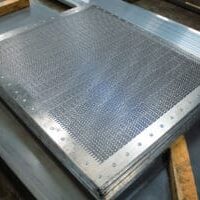
At Roy Manufacturing, we’ve observed a significant shift toward the integration of precision-engineered perforated metal components. These components are no longer just covers or grilles – they’re performance-tuning tools that dictate the aerodynamic and thermal efficiency of a building’s HVAC system.
How Is Perforated Metal Maximizing HVAC Energy Efficiency?
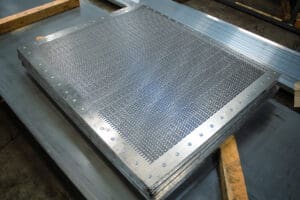
Perforated metal maximizes HVAC energy efficiency primarily by optimizing airflow dynamics and reducing static pressure. The engineered precision in the open area of a perforated component lets air move with minimal resistance. This ensures that system fans and motors operate at peak efficiency, rather than having to work overtime to maintain climate control.
How Does Perforated Metal Optimize Airflow and Static Pressure?
The fundamental challenge in any HVAC system is overcoming resistance. High static pressure is caused by restrictive grilles, poor filtration housings, or inefficient duct transitions. This pressure forces fans to work harder, which consumes more electricity and shortens equipment life spans.
By using custom perforated metal, engineers can dial in the exact open area percentage needed for optimal airflow. Unlike standardized plastic or heavy mesh wire, perforated metal offers a superior strength-to-weight ratio that allows for larger open areas without sacrificing structural integrity. With reduced turbulence and air resistance at the point of delivery, facilities can maintain high-volume air exchanges while significantly reducing the wattage variable-frequency drive (VFD) motors require.
Can Perforated Components Improve Filtration and Air Quality?
Energy efficiency and air quality are often at odds since finer filters usually mean higher resistance. However, you can maximize energy efficiency in HVAC when you use perforated metal as the backbone of your filtration system. From food processing to cleanroom manufacturing, perforated metal screens provide the essential support filter media need in industrial environments.
With our ability at Roy Manufacturing to produce micro-perforated patterns, even the most delicate HEPA and ULPA filters are supported by frames that maximize the surface area exposed to airflow. An optimized support structure means the system experiences less blinded area. This translates to not only a longer filter life but to reduced energy spikes during high-demand cycles.
How Does Architectural Cladding Assist in Passive Thermal Regulation?
One of the most innovative ways to reduce HVAC load is to stop heat before it enters the building. Perforated metal facades and sunscreens act as thermal buffers, leveraging the natural cooling effect of shade to reduce solar heat gain.
Studies have shown that strategic perforated cladding can reduce a building’s cooling load by up to 45%. These components reflect solar radiation while still allowing natural ventilation and daylighting, enabling facilities to downsize their HVAC equipment requirements from the start. It’s a passive-active synergy that stops the mechanical system’s endless uphill battle against the sun.
Why Is Acoustic Dampening Essential for Operational Longevity?
Noise is often a symptom of wasted energy. Vibrations and turbulence signal that a system is working harder than it needs to be. This is another area where perforated metal can maximize HVAC energy efficiency. It’s a premier metal for acoustic attenuation in HVAC silencers and enclosures. By utilizing specific hole patterns and staggered arrangements, perforated panels can diffuse sound waves and reduce backpressure.
When internal components like fans and blowers are housed in precisely engineered perforated enclosures, mechanical resonance is minimized. This leads to a more stable operational environment and reduced energy-intensive on-off cycling that’s common in poorly balanced systems.
Roy Manufacturing is Your Solution for Maximizing HVAC Energy Efficiency
The difference between a standard component and a leadership-grade component lies in the tolerances. A 2% difference in open area may not seem like much, but in HVAC, it can translate to thousands of dollars in annual energy savings for a large-scale facility.
At Roy Manufacturing, we specialize in perforated solutions that help the HVAC industry maximize energy efficiency. Our state-of-the-art Portland, Oregon, facility provides:
- Custom Open-Area Calculations: Our experienced team works with your engineers to ensure hole size, shape, and patterns maximize airflow.
- Material Versatility: From lightweight, corrosion-resistant aluminum for coastal units to heavy-duty stainless steel for industrial scrubbers, we perforate it all.
- Rapid Prototyping and Production: We offer same-day quotes and five-day turnarounds, ensuring efficiency upgrades don’t stall your project timeline.
Energy efficiency in HVAC isn’t just about the motor – it’s about the path the air takes. Precision perforated metal is an investment in the long-term energy performance and sustainability of your facility. Contact us today to see how custom perforation can transform your HVAC project.