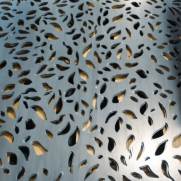
What makes a great retail display? It’s eye-catching. It’s clear. It’s personalized to your brand. And using laser cutting for your retail displays is the best way to achieve all three.
Laser cutting gives retailers, designers, architects, and fabricators the precision and creative flexibility they need to take displays from concepts to distinctive physical spaces. Keep reading to see how retailers can leverage laser cutting for everything from branded signage to dimensional fixtures for their displays.
How Can Laser Cutting Improve Custom Retail Displays?
Laser cutting improves custom retail displays by producing precise shapes, intricate patterns, branded graphics, signage, panels, and fixture components from materials such as metal and acrylic. Retailers can use the process to create distinctive displays with repeatable dimensions, clean details, and flexible designs for storefronts, product showcases, point-of-purchase fixtures, and other branded environments.
Why Choose Laser Cutting for Retail Display Fabrication?
Retail spaces compete for attention at every turn. Generic shelving and signage fade into the background, but custom elements help shoppers recognize a brand and engage with the product.
Laser cutting gives design teams a high level of control over those custom elements. They can specify everything from dimensions and patterns to lettering and decorative details. We’ve also found that using CAD-based production means the same components can be consistently reproduced for displays across multiple stores.
1. Create Custom Laser-Cut Retail Signage
Signage is often the first impression a shopper gets of a retail space. With laser cutting, brands can move beyond standard printed signs and create dimensional logos, lettering, plaques, directional signs, and decorative brand elements.
When designers use laser cutting for retail displays, they can incorporate logos, custom typography, geometric shapes, and other brand-specific details into metal or acrylic components. Laser cutting also makes it possible to accurately repeat those details across multiple signs, which helps maintain visual consistency throughout a store and across multiple locations.
Retailers can use custom laser-cut signage for:
- Store logos and entrance signage
- Department and aisle identification
- Product category signs
- Promotional displays
- Wayfinding elements
- Branded plaques and nameplates
We recommend keeping both viewing distance and installation in mind when designing signage. A detailed design can look impressive close up, but it also has to be readable and recognizable from the shopper’s natural sightline.
2. Build Laser-Cut Point-of-Purchase Displays
The point of POP displays is to capture attention quickly. Custom laser-cut components help achieve this by giving countertop displays, endcaps, freestanding units, and promotional fixtures a distinctive shape that separates the featured products from the surrounding merchandise.
Designers can use laser-cut panels for sidewalls, headers, product dividers, decorative faces, shelves, and structural components. They can also incorporate cutouts or engraved details that reinforce campaign graphics or brand identity.
Outside of appearance, designers should consider how employees will stock the display, how customers will interact with it, and how components will stand up to repeated use. These practical considerations influence material choice, dimensions, edges, openings, and connection points.
We’ve found that laser cutting works particularly well for POP displays going to multiple retail locations. Once the CAD file is finalized, the fabrication process can reproduce detailed components with consistent dimensions across the production run.
3. Add Decorative Laser-Cut Panels to Retail Interiors
Custom decorative panels can transform an ordinary wall, counter, partition, or fixture into a visual feature. Laser cutting enables designers to create retail displays with intricate patterns, perforations, repeating motifs, and custom shapes that connect the physical space to the brand. This can include:
- Feature walls
- Checkout counters
- Display backdrops
- Product bays
- Room dividers
- Window displays
- Ceiling and architectural accents
These panels both serve an aesthetic purpose and define different areas within an open retail environment. A repeated pattern can become a recognizable design that carries throughout the store.
4. Fabricate Custom Retail Shelving and Fixture Components
Retailers often need fixtures that fit a specific product. From shelving to product stands, brackets to faceplates, laser cutting can create custom components for retail displays.
With custom fabrication, brands can develop fixtures around unusual merchandise dimensions. A retailer may need a display that holds products at a specific angle, separates individual items, includes space for signage, or incorporates branded decorative elements. CAD design and laser cutting give the project team the flexibility to solve those challenges within the fixture itself.
Laser cutting’s precision is especially useful when a display involves components that need to be aligned during assembly. Accurate openings, slots, tabs, and edges can help the parts fit together as intended and reduce on-the-fly adjustments during installation.
5. Use Laser Engraving and Cutting for Branded Display Details
Small details are what make custom retail displays feel intentional. Laser engraving and cutting can add brand names, product information, patterns, identification marks, and decorative graphics directly to the display components.
Design teams can use these techniques to create:
- Engraved logos
- Product labels
- Decorative patterns
- Fixture identification
- Branded panels
- Custom plaques
These details build branding directly into the display, which creates a more integrated look than applying separate graphics. We recommend discussing engraving, cutting, forming, and finishing requirements during the design stage to ensure the project’s aesthetic, fit, and functional requirements are met.
What Materials Work for Laser-Cut Retail Displays?
The right material depends on several factors, including the display’s location, appearance, structural requirements, budget, and expected use. For example, high-touch fixtures or long-term installations call for durable metals. Decorative features, however, may call for a different material depending on the finish, weight, thickness, and visual effect.
At Profile Laser, we work with a variety of materials, including stainless steel, aluminum, mild steel, galvanized steel, carbon steel, brass, copper, bronze, acrylic, plastics, and other specialty materials. We recommend discussing your display requirements with your fabrication team early to find a material and approach that works with the design and practical demands of your retail space.
How Does CAD Design Support Custom Retail Display Production?
With CAD design, fabricators have a precise digital foundation for laser-cut components. The design file defines the dimensions, shapes, cutouts, patterns, and other details to ensure accurate results. It also makes revisions easier during development.
For retailers planning multiple installations, CAD-based production helps maintain consistency. Once the project team finalizes a component, the exact same design can be repeated for future locations or replacement parts.
Bring Your Custom Retail Display Design to Life With Profile Laser
Great retail displays highlight branding, function, durability, and visual impact. By leveraging laser cutting, design teams can create custom signs, POP displays, decorative panels, fixtures, and branded details with precision.
At Profile Laser, our experienced team uses laser cutting, engraving, 2D CAD design, forming, finishing, and fabrication for commercial and design applications. Whether you need a unique prototype, a one-off display component, or a large retail rollout production run, we deliver high-quality results on spec and on time.
Ready to put laser cutting to work for your retail displays? Contact us today for a same-day quote.
Frequently Asked Questions
What types of retail displays can you create with laser cutting?
Laser cutting can create components for custom retail signage, point-of-purchase displays, shelving, product stands, decorative panels, display backdrops, branded fixtures, and architectural features. The precision of laser cutting also makes it possible to incorporate custom shapes, patterns, lettering, logos, and other brand-specific details into a retail display.
What materials can Profile Laser cut for custom retail displays?
Profile Laser works with a wide range of materials, including stainless steel, aluminum, mild steel, galvanized steel, carbon steel, brass, copper, bronze, acrylic, MDF, plastics, and specialty materials. The best material depends on the display’s design, location, durability requirements, desired appearance, and intended use.
Can laser cutting create custom logos and branding for retail displays?
Yes. Laser cutting can incorporate logos, lettering, patterns, shapes, and other branded elements directly into retail display components. Laser engraving can add another level of customization for logos, product information, decorative graphics, identification marks, and other details.
Can laser cutting support multi-location retail display rollouts?
Yes. CAD-based laser cutting can reproduce display components with consistent dimensions and details, making it well-suited to projects that require matching components for multiple retail locations.