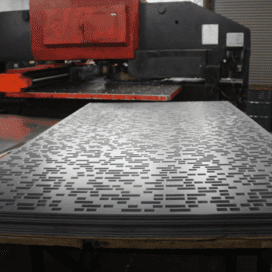
Yes, industrial screens separate materials, but they also influence flow rates, prevent blinding, improve wear life, and support consistent product sizing. Choosing the right hole patterns for these industrial filters is a critical first step to maximizing efficiency and reducing downtime and maintenance costs.
Whether you operate in aggregate processing, recycling, mining, agriculture, or industrial manufacturing, the screen pattern you select directly impacts material separation and system productivity. Keep reading as we dive into how to identify screen configurations that align with your operation’s processing goals and environment.
What Is the Best Screen Hole Pattern for Industrial Filters?
The best screen hole pattern for industrial filters depends on the material being processed, required flow rate, particle size distribution, and wear conditions. Round holes provide versatility and strength, square holes maximize open area and throughput, slotted holes improve separation of elongated materials, and specialty patterns address unique filtration challenges. Matching the pattern to the application delivers optimal performance.
How Screen Hole Patterns Optimize Industrial Filtration
The geometry of a screen opening affects how materials move through the filtration process. Open area percentage, hole spacing, structural strength, and wear characteristics are all directly affected by the selected pattern.
When engineers only focus on hole size, they overlook how the arrangement of the openings influences filter performance. The right pattern can increase production capacity, improve separation accuracy, and extend screen life. The wrong pattern, however, can create bottlenecks, increase maintenance demands, and reduce product quality.
In our experience, facilities that evaluate both the hole size and pattern configuration see more consistent filtration results and lower operating costs.
Round Hole Screen Patterns for Industrial Filters
Round holes are the most commonly used perforation pattern in industrial filtration applications. They provide the highest structural integrity and support efficient material flow. Round hole screens work especially well for:
- General-purpose screening
- Aggregate processing
- Mining operations
- Agricultural material handling
- Industrial filtration systems
The circular shape evenly distributes stress across the screen, which helps reduce cracking and premature wear. Round holes also resist deformation under heavy loads, which makes them a go-to option for high-volume processing environments.
We recommend round hole patterns when operators need a proven solution that provides durability, capacity, and screening accuracy.
How Do Square Hole Patterns Improve Throughput?
Square hole patterns provide a higher percentage of open area compared to round hole designs. This increased open area allows more material to pass through the screen surface, which can significantly increase throughput.
Facilities frequently choose square hole patterns for industrial filters when they need:
- Higher production rates
- Improved material flow
- Efficient sizing operations
- Maximum screening capacity
Because square openings expose more open space within the same screen area, they allow greater volumes of material to pass through the filter. However, that higher percentage of open area can turn the filter’s corners into weak points, making it more susceptible to wear.
We’ve found that square-hole patterns are optimal for operations that prioritize capacity over extreme durability.
When Should You Use Slotted Hole Screen Patterns for Industrial Filters?
Slotted hole patterns are excellent for filtering elongated, fibrous, or irregularly shaped materials. Unlike round or square holes, slotted holes let operators control separation based on the particle’s orientation. Common slotted hole pattern applications include:
- Wood processing
- Recycling systems
- Pulp and paper operations
- Agricultural processing
- Water treatment systems
Slotted openings can both increase the effective screening area and help maintain material retention requirements. They also improve drainage and dewatering performance in many applications.
Based on client results, slotted hole patterns for industrial filters provide better classification accuracy for materials that don’t see repeatable results with conventional round-hole configurations.
Factors to Consider When Selecting Screen Hole Patterns for Industrial Filters
There are several technical factors to consider when making your hole pattern selection.
Material Characteristics
Particle size, shape, moisture content, density, and abrasiveness all influence how well a screen performs. Materials with irregular shapes may benefit from slotted hole patterns, while round or square openings tend to work well for uniform particles.
Open Area Requirements
A higher open area generally increases throughput. However, that increased open area can reduce the structural integrity. Engineers must balance production goals with durability requirements when selecting hole patterns for industrial filters.
Wear Conditions
Highly abrasive materials put a significant amount of stress on screening surfaces. For these applications, stronger hole patterns and thicker materials translate to a longer service life.
Flow Rate Objectives
Applications that demand maximum throughput may emphasize open area. Precision separation processes, on the other hand, typically focus on classification accuracy.
Maintenance Demands
Some hole patterns are better at combating blinding and clogging than others. Taking these types of maintenance requirements into consideration during the design phase can help reduce operational disruptions later.
How to Match Screen Hole Patterns to Your Application
We recommend following these steps when considering industrial filter screen configurations:
- Define the target particle size range.
- Analyze material characteristics and moisture levels.
- Determine required throughput capacity.
- Evaluate wear and impact conditions.
- Calculate open area requirements.
- Select a pattern that balances strength and performance.
- Review maintenance and cleaning considerations.
By using this systematic approach, operators can effectively avoid costly screening inefficiencies and support long-term productivity.
Custom Perforated Screen Solutions for Industrial Filters
Many industrial applications call for more than standard hole patterns. By implementing custom perforation designs, manufacturers can address their unique processing challenges to optimize efficiency. Custom configurations may look like:
- Specialized hole shapes
- Variable spacing patterns
- Multi-stage screening designs
- Application-specific open area targets
- Enhanced wear-resistant materials
At Roy Manufacturing, we work with customers to evaluate their operating conditions and recommend perforated screen solutions that meet their objectives. With our engineering expertise and manufacturing capabilities, we help facilities improve their filtration performance and minimize downtime.
Frequently Asked Questions
Which screen hole pattern provides the highest open area?
Square hole patterns generally provide higher open area percentages than round holes, allowing increased material flow and throughput.
Are round hole screens stronger than square hole screens?
Yes. Round hole patterns distribute stress more evenly and typically offer greater structural strength under heavy operating conditions.
When are slotted screen openings most effective?
Slotted openings perform best when screening elongated, fibrous, or irregularly shaped materials that require orientation-based separation.
Can custom perforation patterns improve filtration performance?
Yes. Custom screen designs can optimize flow rates, separation accuracy, wear resistance, and maintenance performance for specific industrial applications.
Why Manufacturers Choose Roy Manufacturing for Industrial Filters
Choosing the right hole patterns for industrial filters starts with a careful evaluation of material characteristics, throughput goals, wear conditions, and maintenance requirements. Working with an experienced perforated metal manufacturer like Roy Manufacturing ensures that you choose a screen solution that’s optimized for your specific application.
For over 60 years, our team has delivered quality, reliable results across industries. We have the experience and capabilities to deliver custom solutions that improve your filtration efficiency, increase productivity, and reduce your long-term operating costs. Contact us today for a same-day quote.