Perforated Metal in Aquaculture
Aquaculture is scaling fast, and that growth raises the question: what materials can stand up to constant immersion, aggressive cleaning, biofouling, and continuous use? Increasingly, the answer is perforated metal. More than just “a sheet with holes,” perforated metal can be used in aquaculture as an adaptable, engineered surface that can improve water quality, animal welfare, maintenance cycles, and structural reliability.
Why Perforated Metal Belongs in Modern Aquaculture Design
At its core, aquaculture is controlled fluid dynamics. Whether you’re raising salmon, trout, or eggs, your success depends on managing flow, oxygenation, waste transport, and containment. Perforated metal helps with all of this because it lets you precisely balance open area (how much water passes through) with strength (how much load the structure can carry).
That matters in real-world use cases, such as:
- Cage and pen components: Perforated panels can be used as rigid partitions, predator-resistant barriers, or reinforced zones near high-wear points. These are all areas where traditional netting tends to tear, deform, or require frequent replacement.
- Screens and intake protection: Well-designed perforations reduce debris intrusion while maintaining a consistent flow. That means fewer clogs, less pump strain, and more stable operating conditions.
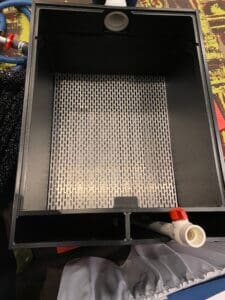
- Raceways and tank internals: Baffles, diffuser plates, and grading panels benefit from predictable hydraulic performance. This supports uniform circulation and reduces dead zones where waste can settle.
- Walkways, platforms, and service structures: Slip-resistant perforated tread plates improve worker safety and drainage in wet environments, all without sacrificing load rating.
In each case, the perforation pattern is more than just aesthetics -it’s performance. Round holes, slots, staggered patterns, and custom geometries each behave differently under flow and load. When you treat metal perforation as an engineering variable, you get aquaculture structures that perform better and last longer.
The Hidden Advantages: Cleaning, Biofouling, Uptime
Aquaculture teams spend a lot of time maintaining systems that are constantly trying to become ecosystems of their own. Biofouling isn’t just an inconvenience – it increases weight, reduces flow, raises disease pressure, and adds labor.
Perforated metal helps address this problem in aquaculture on two fronts:
- Cleanability: Rigid panels tolerate high-pressure washing and mechanical cleaning. They don’t stretch, sag, or trap debris the same way flexible materials do.
- Consistency over time: When the structure retains its shape, flow and containment assumptions remain valid. This reduces the slow drift in performance that can happen as materials fatigue.
All of this translates to a business outcome operators deeply care about: uptime. Using perforated metal in aquaculture leads to fewer emergency repairs, less unplanned maintenance, and more predictable production.
Material Selection: Corrosion Isn’t Optional
Aquaculture doesn’t forgive material shortcuts. Saltwater, brackish systems, disinfectants, and constant abrasion quickly expose weaknesses. That’s why perforated metal choices start with material science.
- 316/316L stainless for strong corrosion resistance and broad compatibility
- Duplex stainless for higher strength and more aggressive environments
- Marine-grade aluminum for weight-sensitive structures with proper isolation design
- Coated carbon steel for freshwater/low-corrosion areas where cost efficiency is key (with careful coating spec and inspection)
The right choice depends on species, salinity, temperature, cleaning chemistry, and expected service life.
Roy Manufacturing Brings the Aquaculture Solution Set Together
At Roy Manufacturing, we approach aquaculture structures the way operators experience them: as systems that must hold up under real conditions, not lab assumptions. We produce perforated metal solutions for flow, strength, and long-term durability, backed by manufacturing capabilities that scale.
That means:
- Custom perforation patterns and open-area targets to meet hydraulic and containment requirements
- Fabrication built for marine environments, including formed panels, guards, screens, and service platforms
- Welded assemblies and modular components designed for maintenance access and field replacement
- Finishing options aligned to corrosion risk, including passivation and protective coatings
- Quality controls and traceability to support consistent builds across multi-site operations
At Roy Manufacturing, we collaborate early – because metal delivers its biggest ROI when it’s designed into the structure, not retrofitted after failures.
Your Farm Works Harder with Roy Manufacturing
Aquaculture is an industry where the smallest design decisions have a big impact on feed conversion, mortality rates, labor hours, and downtime. Perforated metal is your competitive advantage – structural, adaptable, cleanable, and built for the long haul.
If you’re evaluating upgrades or building your next generation of aquaculture infrastructure, Roy Manufacturing is ready with the expertise and production capacity to help you make perforated metal work harder for your farm. Contact us today to get started.