Roy Mfg Knowledge Base
Hole size, shape, and spacing get a lot of consideration in perforated metal design. But let’s not forget about the margins. Margins play just as big a role in how a finished perforated panel looks and performs. They affect everything from fabrication to installation for industrial equipment, architectural screens, ventilation systems, and more. Here’s what you need to know about standard margins vs. no margins in perforated metal so you can choose the right configuration for your project.
What Is the Difference Between Standard Margins and No Margins in Perforated Metal?
Standard margins leave solid, unperforated material along the edges of a sheet or panel. When there’s no margin, the perforation pattern is extended all the way to the edge of the metal. Standard margins provide space for mounting, fastening, and fabrication, while no margins is ideal for continuous screening or panels that butt up against each other.
What Are Standard Margins in Perforated Metal?
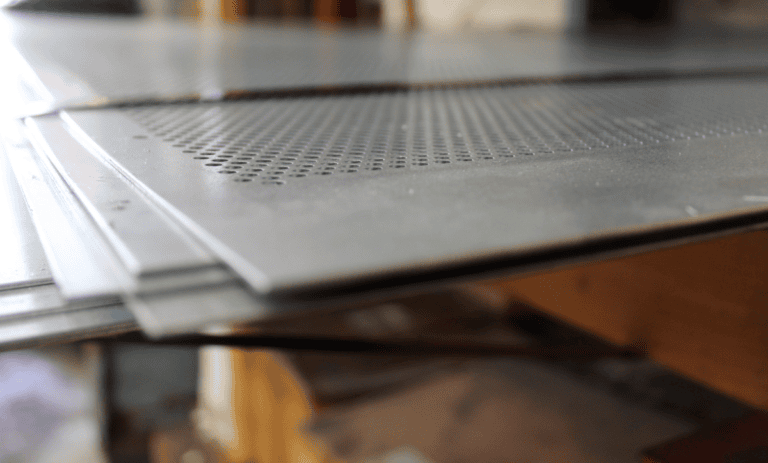
Standard margins are the solid, unperforated borders around a perforated metal sheet. These borders separate the hole pattern from the sheet’s outer edges, leaving space for additional fabrication or installation requirements. Keep in mind that the term “standard” doesn’t mean every manufacturer uses the same dimensions – the actual margin widths depend on the tooling, pattern, and specifications.
Benefits of Standard Perforated Metal Margins
In our experience, standard margins have several practical advantages, especially for industrial and structural applications.
- More room for mounting: Solid borders leave space for bolts, rivets, screws, and other fasteners without interfering with the perforation pattern.
- Additional fabrication options: Unperforated edges simplify certain bending, welding, and forming operations.
- Improved edge durability: Solid borders help reduce the risk of edge distortion or damage during handling and installation.
- Cleaner panel framing: Consistent margins create a defined border that works well with frames and mounting systems.
- Greater flexibility: Manufacturers can use solid edges to accommodate assembly requirements and some secondary operations.
Let’s take an industrial equipment manufacturer, for example. This manufacturer specifies perforated steel panels that need to accommodate mounting holes. When those panels are produced with standard margins, the fasteners can be placed along the solid border rather than through the perforated area.
Keep in mind, however, that specifying standard margins means less perforated area that’s available for airflow, drainage, or other functions. Designers need to account for that reduction when they calculate a panel’s overall open area.
What Does No Margins Mean in Perforated Metal?
No-margin perforated metal has a hole pattern that extends all the way to the edges of the sheet instead of stopping to create a solid border. You may sometimes hear manufacturers refer to this configuration as an all-over perforation pattern.
It’s important to note that “no margins” doesn’t necessarily mean every edge will have a complete hole. Depending on the perforation process, sheet dimensions, and pattern layout, the finished panel may have partial holes or small amounts of solid material along the edges. If your project demands a precise edge appearance, confirm the hole pattern with your fabricator before production starts.
Benefits of No-Margin Perforated Metal Panels
We’ve found no-margin designs are ideal for applications where continuous perforations and visual consistency are key.
- Continuous appearance: Extending the perforation pattern toward the edges creates a more uniform visual effect.
- Potentially greater total open area: Reducing solid borders can increase the perforated surface area across the panel.
- Architectural flexibility: No-margin designs help create consistent patterns across adjoining panels.
- Efficient use of panel space: More of the sheet can be used for ventilation, screening, or drainage.
In our experience, architectural designers often choose no-margin panels for decorative screens, building facades, and other applications where a large solid border interrupts the aesthetic. However, designers should keep in mind that extending the perforations to the edges may lead to additional framing, reinforcement, or specialized mounting methods.
What Are the Key Differences Between Standard Margins and No Margins?
Both configurations have their advantages. Here’s how they compare.
Standard Margins
- Solid, unperforated borders
- Defined border around the hole pattern
- Provides solid material for fasteners
- Can simplify bending and welding near the edges
- Solid borders reduce total panel open area
- Ideal for equipment guards, filters, and industrial panels
No Margins
- Perforations extend to the sheet edges
- More continuous perforated appearance
- May require alternative mounting methods
- May require additional fabrication planning or reinforcement
- Can increase total panel open area
- Ideal for architectural screens, decorative panels, and ventilation
How Do Perforated Metal Margins Affect Strength and Structural Integrity?
Margins directly affect how a perforated panel distributes loads, particularly near its edges and mounting points. With standard margins, solid material surrounds the perforation pattern to provide additional support around fasteners and help resist deformation during installation or handling. No-margin panels, on the other hand, may increase the risk of edge distortion or tearing under concentrated loads thanks to having less solid material at the edges.
Note that margins alone don’t determine the strength of a panel. Engineers also need to consider:
- Metal type and mechanical properties
- Sheet thickness or gauge
- Hole diameter and shape
- Perforation spacing and staggered or straight patterns
- Panel dimensions and unsupported spans
- Fastening methods and expected loads
How Do Margins Affect Perforated Metal Open Area and Airflow?
Two panels can use identical perforation patterns but have completely different total open-area percentages based on their margins.
For example, consider two panels that both measure 24” x 48”. Both panels use a perforation pattern with 40% open area. The first panel has a 2” solid margin on all four sides, leaving a perforated region that measures 20” by 44”. The second panel has its pattern extended across the entire sheet. Here’s how their total open areas compare.
- Standard-margin panel: 20 × 44 × 0.40 = 352 square inches of open area, or approximately 30.6% of the full panel
- No-margin panel: 24 × 48 × 0.40 = 460.8 square inches of open area, or 40% of the full panel
This is a simplified example, but you can see how the no-margin panel provides approximately 31% more total open area than the standard-margin panel. Understanding these differences helps designers meet performance requirements for applications like data center ventilation panels, HVAC screens, and industrial filtration systems.
How Do Perforated Metal Margins Affect Fabrication?
Margin selection should be carefully considered since it affects downstream manufacturing processes, including cutting, bending, welding, and assembly.
Bending and Forming Perforated Metal
Bending through perforated material changes how the sheet responds to forming forces and may create distortion around the holes. That’s why manufacturers prefer solid margins for planned bends or flanges.
Welding and Joining Perforated Panels
Welding directly through or near perforations in no-margin panels often complicates joint design because holes interrupt the available material. Solid margins, however, make it easy to achieve the intended assembly by providing convenient spots for welding and other joining operations.
Cutting and Finishing
Cutting a perforated sheet to its final dimensions may create partial holes along the edges. These openings can leave sharp points or irregular edge profiles that need additional finishing, like deburring, edge finishing, or framing.
Which Applications Work Best With Standard Margins or No Margins?
Different industries have different priorities that affect their perforated metal specifications.
Industrial Equipment Guards and Machine Screens
Standard margins generally make sense for applications like equipment guards, machine screens, and industrial enclosures. We’ve found that these applications need secure mounting and durable edges that can withstand routine handling or vibration, and solid borders help meet those requirements.
Architectural Perforated Metal Panels
No-margin designs tend to work well for architectural facades, decorative wall panels, privacy screens, and other applications where pattern continuity is essential.
HVAC and Data Center Ventilation Panels
Ventilation applications have to balance open area and structural support. No-margin designs generally increase the perforated surface area that’s available for airflow, but standard margins provide solid areas for attaching panels to equipment or frames. To determine the best choice, engineers should calculate the total open area and evaluate the entire airflow system.
Filtration and Material Separation
Like ventilation panels, both standard-margin and no-margin designs have their advantages for industrial filters, screens, and separation equipment. Standard margins are useful for sealing and mounting surfaces, while no-margin configurations can maximize the available perforated region. Your fabricator can help you make the right choice depending on your equipment’s construction, sealing requirements, and intended operating conditions.
How Do You Choose the Right Perforated Metal Margin Configuration?
We recommend evaluating your entire application before specifying standard or no margins.
- Identify the panel’s primary function. Determine whether the design prioritizes airflow, filtration, appearance, protection, or structural support.
- Review mounting requirements. Identify where fasteners, welds, frames, and other attachment points will connect to the panel.
- Calculate the required open area. Account for solid borders when evaluating ventilation or drainage performance.
- Consider secondary fabrication. Determine whether the panel needs bending, forming, welding, or additional finishing.
- Evaluate edge conditions. Decide whether the application can accommodate partial holes or requires continuous solid edges.
- Confirm manufacturing capabilities. Discuss hole patterns, material specifications, tolerances, and margin requirements with your perforated metal manufacturer.
Work With Roy Manufacturing for Custom Perforated Metal
Choosing between standard margins and no margins is another piece of designing an effective perforated metal component. Like material selection, perforation patterns, sheet dimensions, and fabrication requirements, it affects everything from appearance to performance.
At Roy Manufacturing, we’ve spent over 60 years considering every aspect involved in creating effective custom perforated panels. We know industrial and architectural applications are rarely one-size-fits-all, and our in-house capabilities enable us to deliver components that meet your exact specifications. Whether you need standard margins for equipment mounting or no margins for an architectural application, our team can find the right solution for your project. Contact us today for a same-day quote.
Frequently Asked Questions
What is a standard margin in perforated metal?
A standard margin is a solid, unperforated border around a perforated metal sheet or panel. Manufacturers use margins to provide space for mounting, fastening, bending, and other fabrication operations.
Does no-margin perforated metal have holes all the way to the edge?
Not necessarily. No-margin perforated metal extends the hole pattern toward the sheet edges, but the finished panel may contain partial holes or small unperforated areas. The exact edge condition depends on the perforation pattern, manufacturing process, and final dimensions.
Are standard margins stronger than no margins?
Standard margins can provide additional solid material around mounting points and panel edges, which may improve resistance to certain localized loads. However, overall strength depends on material thickness, hole geometry, panel dimensions, and installation conditions.
Can you customize the margin width on perforated metal?
Yes. Many perforated metal manufacturers offer custom margin configurations based on material, hole pattern, tooling, and fabrication capabilities. Customers should specify required border dimensions and tolerances when requesting a quote.
Which margin option is best for architectural perforated metal?
No-margin perforated metal tends to suit architectural applications that prioritize continuous patterns and visual consistency. Standard margins may work better when the panels need solid edges for framing or fastening. The best option depends on the design, mounting system, and structural requirements.