Roy Mfg Knowledge Base
Perforated metal can solve a lot of challenges, like airflow, screening, filtration, protection, and appearance. But that’s not to say it doesn’t come with occasional problems. In our experience, the most common perforated metal problems stem from projects that start with the wrong specs. Here’s how to identify potential issues before production so you can avoid problems with fitment, airflow, wear, and design.
What Are the Most Common Perforated Metal Problems?
Common perforated metal problems include incorrect hole size or spacing, too little or too much open area, inadequate material thickness, dimensional issues, screen blinding, poor pattern selection, and specifications that overlook secondary fabrication. Many of these problems can be prevented by defining your application requirements first, then selecting the material, perforation pattern, dimensions, and fabrication details around them.
How Does Choosing the Wrong Perforation Pattern Cause Problems?
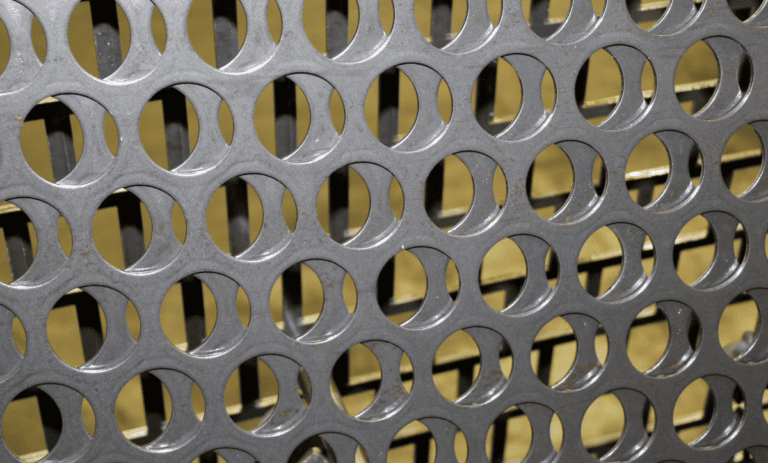
One of the most common perforated metal problems comes from choosing a pattern based on appearance instead of functionality. Different holes interact differently with air, liquids, particles, and bulk materials. For example, slotted holes are ideal for handling elongated, fibrous, irregular, or moisture-heavy materials, while square holes are well-suited for providing maximum airflow and visibility.
Before you specify a pattern, consider:
- The material, air, liquid, or light that needs to pass through the openings
- The size and shape of particles in screening applications
- Required airflow or throughput
- Drainage requirements
- Structural loads
- Wear and impact conditions
- Visual and privacy requirements
In our experience, starting with the application instead of the hole pattern helps customers narrow down the right specifications much more efficiently.
How Can Incorrect Hole Size and Spacing Affect Perforated Metal?
Hole size and spacing work together. Changing either spec changes how much solid material remains in the sheet and affects airflow, filtration, visibility, strength, and appearance.
For example, a ventilation panel with openings that are too small or spaced too far apart may restrict airflow. Likewise, closely spaced openings can increase open area, but that close spacing can also affect the panel’s structural performance.
Dimensional accuracy also makes a difference to your perforated panel. Hole-size variations, uneven spacing, and other inconsistencies all affect airflow, open-area percentages, equipment fit, and installation. That’s why we recommend defining what the goal of the openings is before finalizing the hole dimensions and centers.
Why Does Open Area Cause Perforated Metal Performance Problems?
Open area is the percentage of the sheet or plate that consists of openings. More open area generally allows more air, light, liquid, or material to pass through the component. However, increasing the open area removes more metal from the sheet, which creates a balancing act between throughput and structural strength.
Not enough open area can lead to problems like restricted airflow, inadequate drainage, and reduced screening throughput. Too much open area, however, can create a different set of problems if the remaining metal can’t meet the application’s structural requirements.
This is why open area shouldn’t be treated as an isolated spec: it should be evaluated alongside hole size, spacing, material type, thickness, and expected loads.
How Does the Wrong Material Thickness Create Perforated Metal Problems?
Material thickness directly affects weight, rigidity, durability, fabrication, and the way a perforated component performs after it’s installed. A thin sheet, for example, may work perfectly for a lightweight decorative application, but it typically lacks the rigidity required for a large exterior panel or demanding industrial component. However, automatically specifying a thicker material for your project can add unnecessary weight and cost without actually improving the application.
Perforation further complicates this decision because every opening removes material. As the open area increases, designers need to consider how much metal is left to support the panel. We’ve found that the best way to choose your material thickness is to factor in both the material and the perforation pattern, rather than treating each as a standalone spec.
What Causes Screen Blinding in Perforated Metal?
Screen blinding is when material lodges in or covers the perforations, reducing the effective open area. This common problem with perforated metal decreases throughput and interferes with consistent screening performance.
Irregular, elongated, fibrous, and moisture-heavy materials in particular create blinding problems. In some applications, slotted perforations provide additional room for these materials to orient themselves and move through the screen. However, simply switching to slots doesn’t guarantee a solution. Particle dimensions, moisture, material flow, opening size, spacing, and equipment operation also play a role.
This is why you should never choose a perforation pattern solely from a catalog. Instead, evaluate the actual material that the screen will process.
How Can Poor Material Selection Shorten Perforated Metal Life?
The right perforation pattern won’t compensate for the wrong metal. When choosing a material, keep your application’s operating environment in mind. For example, an indoor decorative component faces very different conditions than an outdoor screen, industrial filter, or equipment enclosure.
Before choosing a material, identify your application’s:
- Environmental exposure
- Corrosion requirements
- Expected wear and abrasion
- Weight restrictions
- Required strength
- Appearance requirements
- Finishing requirements
- Expected service life
Selecting your metal based on the operating environment helps extend the component’s lifespan by reducing premature corrosion, deformation, and replacement costs.
Why Should You Plan for Bends, Margins, and Secondary Fabrication?
Perforation is often just the first step in a manufactured component. Many parts still need shearing, forming, deburring, welding, finishing, or other secondary operations.
One of the most common perforated metal problems we see is a perforation layout that only accounts for the flat sheet, rather than the finished component. Edge margins, bends, mounting points, hardware locations, panel dimensions, and secondary operations should be considered early in the design process.
How Can Incomplete Specifications Lead to Costly Mistakes?
We’ve found that many common perforated metal problems start before production. Missing or unclear specs lead to unnecessary questions, delays, or components that don’t perform as expected.
While you don’t need to have every spec finalized, you should at least provide:
- Hole size and spacing
- Material type
- Material thickness
- Required quantity
For more complex components, you may also need to define panel dimensions, open area, margins, pattern orientation, tolerances, and secondary fabrication requirements.
How Can You Prevent Common Perforated Metal Problems Before Production?
The easiest problem to solve is the one you identify before production begins. A detailed spec process gives your perforator the information they need to determine whether your material, pattern, dimensions, and performance goals work together.
Answer these questions before submitting an order or RFQ.
- What’s the objective of the perforated component?
- What needs to pass through the openings?
- What hole size, shape, and spacing support that goal?
- How much open area does the application require?
- How much structural strength does the component need to maintain?
- What material and thickness fit the operating environment?
- Will the component require bends, margins, mounting holes, or other fabrication?
- What dimensions and tolerances does the finished part have to meet?
- Can you provide drawings or plans that clarify the application?
In our experience, this approach helps prevent performance issues and reduces redesigns, production delays, and unnecessary costs.
Avoid Perforated Metal Problems with Roy Manufacturing
An effective perforated metal component starts with understanding the application. Choosing the right combination of material, thickness, hole size, spacing, pattern, open area, dimensions, and fabrication details all helps you avoid common perforated metal problems.
At Roy Manufacturing, our experienced team can review your drawings, performance requirements, and production needs to recommend an effective solution for your application. We’ve supplied stock and custom perforated metals and materials nationwide for over six decades from our Portland, Oregon, shop. Whether you’re troubleshooting an existing component or developing a new one, contact us today for a same-day quote.
Frequently Asked Questions
What are the most common perforated metal problems?
Common perforated metal problems are incorrect hole size or spacing, inadequate open area, the wrong material thickness, poor material selection, screen blinding, dimensional issues, and specifications that don’t account for secondary fabrication. Careful planning before production can prevent many of these issues.
How can I prevent problems with perforated metal open area?
Start by determining how much air, liquid, light, or material needs to pass through the panel. Then evaluate the open area together with hole size, spacing, material thickness, and structural requirements. Keep in mind that increasing the open area can improve flow, but it also removes more material from the sheet.
What causes perforated metal screens to become clogged or blinded?
Screen blinding occurs when particles lodge in or cover the perforations and reduce the usable open area. Material shape, size, moisture content, hole geometry, spacing, and screen operation can all contribute. Selecting the right perforation pattern for the material being processed helps reduce this problem.