Profile Laser Knowledge Base
With forming and shearing, you can add dimension to a flat, 2D sheet, transforming it into 3D parts with structural integrity and functional utility.
At Profile Laser, we know that a flat, laser-cut part is often just the first step in metal fabrication. The real magic happens during the secondary stages: forming and shearing. Here’s how we use specialized techniques to reshape and refine your projects, taking them from flat to functional.
How Do Precision Forming and Shearing Add Dimension to Components?
In metal fabrication, forming and shearing are the primary methods for transforming a 2D flat-cut sheet into a functional 3D component. While laser or waterjet cutting defines the perimeter, these secondary processes provide the part’s structural depth and final geometry.
The Power of Sheet Metal Forming: From 2D Designs to 3D Solutions
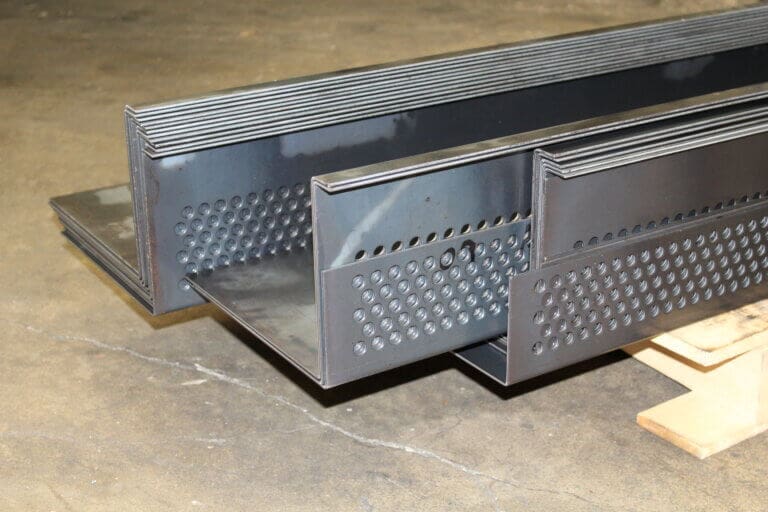
Laser cutting provides the absolute accuracy needed for complex component perimeters, but forming is what gives that part its bones. Forming adds dimension to parts by bending or shaping them to create structural features like flanges, brackets, and enclosures.
Precision Bending and Press Brake Versatility
At the heart of our forming department is the Amada RG-50 Press Brake. This machine lets us take a flat-cut piece of stainless steel, aluminum, or carbon steel and apply precise bends at specific angles. This forming process is essential for creating:
- Structural Rigidness: A flat sheet of metal is flexible; a sheet with a 90-degree bend is a structural component. Forming adds stiffness to the metal without adding extra weight.
- Complex Geometries: By incorporating multi-stage bending, we can create intricate shapes that would otherwise require expensive welding or casting.
- Enclosures and Chassis: From electrical boxes to medical device houses, forming lets us create seamless corners and protective shells directly from a single laser-cut blank.
Strategic Shearing: Efficiency and Edge Quality in High-Volume Production
Laser cutting may be the go-to for intricate shapes, but we often recommend shearing for large-scale production. It’s one of the most efficient ways to manage straight-line cuts and prep work. At Profile Laser, we use the Accushear 12’ x ¼” Metal Shear to create high-speed, high-accuracy straight cuts.
Improving Material Yield and Production Speed
Shearing is a subtractive process. It uses a blade to separate large sheets into smaller, manageable blanks. In our experience, this provides several distinct advantages for high-volume manufacturing:
- Speed: A shear is significantly faster than a laser for long, straight cuts. This means we can prep materials for secondary operations in a fraction of the time.
- Edge Consistency: Shearing provides a clean, square edge that’s ideal for parts that will eventually be welded or joined.
- Cost-Effectiveness: By combining laser cutting for the details and shearing for the straightaways, we can optimize your production schedule and reduce the overall cost per part.
How Do These Secondary Processes Work Together to Finalize a Part?
By working with a full-service fabrication partner like Profile Laser, you can integrate these processes to add dimension to your parts under one roof. We provide CAD design, fiber laser cutting, forming, and shearing to create a streamlined workflow that effectively eliminates the logistics delays of dealing with multiple vendors.
The Role of CAD in Formability
Before the first spark flies from our TRUMPF 3030 Fiber Laser, our team uses CAD technology to simulate the forming process. We account for everything from springback to material thickness to ensure that the final 3D part matches your digital model exactly. This design-for-manufacturability approach ensures that every bend is accurate to within thousands of an inch.
Frequently Asked Questions
Can forming replace welding for 3D parts?
In many cases, yes. By strategically using our press brakes to bend a single sheet of metal into a complex shape, we can often eliminate the need for corner welding. This creates a cleaner, more aesthetic look, while also reducing labor costs and maintaining the structural integrity of the base material.
How do you ensure the dimensions stay accurate after bending?
Metal has a property called springback, where it naturally tries to return to its flat state after being bent. Our operators use precision CAD unfolding to calculate the exact bend allowance needed. We adjust the press brake pressure and angle to account for the specific material type, ensuring the final 3D dimensions are spot-on.
Can you form parts cut by both laser and waterjet?
Absolutely. Whether your part was cut using a fiber laser for speed or a waterjet for thick, heat-sensitive materials, we can move those blanks directly into our forming department for 3D shaping.
Find Custom Solutions with Profile Laser
Our ability to add dimension to parts through forming and shearing makes us a preferred partner for an array of sectors:
- Architectural Design: Creating custom metal signs, decorative facades, and interior partitions that demand both aesthetic beauty and structural mounting points.
- Industrial Manufacturing: Producing heavy-duty brackets, heat shields, and machine guards that must withstand harsh environments.
- Prototyping: Rapidly iterating 3D parts from 2D designs to help engineers test fit, form, and function before moving to full-scale production.
Adding dimension and utility to your flat-cut parts doesn’t have to be a multi-vendor headache. By leveraging Profile Laser’s forming and shearing capabilities, you can ensure your project is held to the highest precision and craftsmanship standards – all under one roof. Contact us today for a same-day quote.