Roy Mfg Knowledge Base
Once confined to rigid walls and unmoving facades, architecture is no longer a static discipline. Today, the most innovative structures are ones that breathe, shift, and adapt to their environment through kinetic design. At the heart of this evolution? Perforated metal. Keep reading to learn how perforated metal provides the perfect balance of structural integrity and lightweight flexibility required by kinetic architecture.
How Is Perforated Metal Used in Kinetic Architecture?
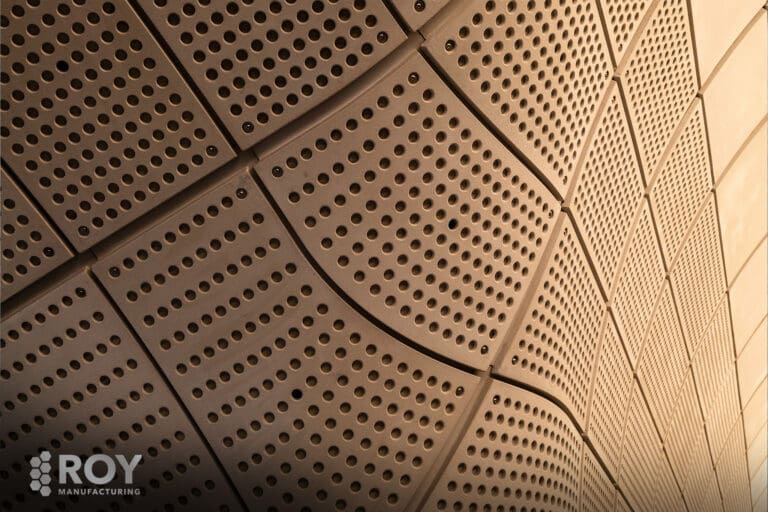
Kinetic architecture uses perforated metal to create responsive facades, sunshades, and privacy screens that physically move or rotate. Its high strength-to-weight ratio allows mechanical mobility without overstraining structural systems. Architects can control light filtration, airflow, and transparency by varying hole patterns, enabling buildings to dynamically adapt to environmental factors such as solar orientation and wind speed.
Leveraging Perforated Metal in Modern Facade Systems
In our experience, the primary challenge of kinetic architecture is managing the weight of moving parts. Heavy materials require massive motors and complex engineering that can quickly inflate a budget. We’ve found that perforated metal solves this problem by reducing the overall mass of the panel without sacrificing its face, or visual impact.
Whether it’s a geometric array for a modern retail space or a more organic distribution for an art installation, the precision of our CNC turret punch presses ensures that every moving component aligns perfectly within the kinetic system. This precision is vital because even a millimeter of deviation can cause mechanical binding in a moving facade.
Optimizing Energy Efficiency with Responsive Metal Screens
One of the most practical applications of perforated metal in kinetic architecture is the management of solar heat gain. Unlike fixed shades, kinetic screens can track the sun throughout the day. These moving perforated panels can significantly reduce HVAC loads by blocking direct glare while still allowing natural ventilation to permeate the building envelope. This dual-purpose functionality is why we’re seeing an uptick in the use of perforated metal for LEED-certified projects.
At Roy Manufacturing, we produce perforated products designed to withstand the constant mechanical cycles of these systems. When a panel moves hundreds of times a year, its durability and finish quality are paramount. From grain millers to government facilities, our clients rely on us to provide materials that continue to look good and perform after years of environmental exposure in the Pacific Northwest and beyond.
Aesthetic Versatility: From Industrial to Artistic
Kinetic architecture is about engineering, but it’s also about art. Perforated metal lets designers play with moiré effects in kinetic architecture – the optical illusion that’s created when two patterns overlap to create a third pattern. When two perforated layers move against each other, it creates a shimmering, living skin on a building that changes as pedestrians walk by or as the mechanical system shifts. Our projects often involve collaborating with artists and designers who want to push the boundaries of how light and shadow interact with metal.
At Roy Manufacturing, we offer endless possibilities for hole styles, including round, square, and decorative patterns. This variety ensures a kinetic screen can be tailored to a neighborhood’s specific vibe. Whether it’s the industrial aesthetic of a converted warehouse or the sleek, high-tech look of a corporate headquarters, we have the right gauge and material for your specific kinetic application.
Engineering for Longevity and Performance
When designing for movement, fatigue testing is the ultimate measure of success. Moving parts are subject to different stresses than static ones. Our team at Roy Manufacturing works to ensure that perforations don’t create weak points that could lead to cracking under the stress of constant motion.
We also understand that kinetic projects often involve complex installation timelines. We know that a delay in a single component can stall the entire project. That’s why we emphasize reliability and communication, ensuring on-time delivery as your project moves from the CAD screen to the construction site.
Frequently Asked Questions
What perforated metal materials are best for outdoor kinetic perforated screens?
Aluminum is typically preferred for kinetic systems due to its lightweight nature and natural corrosion resistance. However, stainless steel is frequently used for high-durability requirements or specific aesthetic finishes. The choice depends on the mechanical load of the motor system and the local climate.
Can you provide custom hole patterns for artistic kinetic facades?
Yes, we specialize in custom perforated products. We can utilize CAD designs to create unique patterns that achieve specific transparency levels or visual effects, allowing the building’s skin to transform as it moves.
What is the typical turnaround time for custom perforated metal orders?
While turnarounds vary based on complexity, we pride ourselves on efficiency. We provide same-day quotes and typical delivery is within five day from receipt of order.
Ready to Transform Your Project with Kinetic Metal?
If you’re looking to integrate dynamic movement and high-performance perforated metal into your next architectural project, the experts at Roy Manufacturing are ready to help. From custom hole patterns to precision fabrication, we have the tools and experience to meet your exact specifications on time, every time. Contact us today for a same-day quote.