Roy Mfg Knowledge Base
When it comes to machining metal, precision is far more than a technical detail—it is the foundation of performance, safety, and trust. A fraction of an inch can mean the difference between a component that functions flawlessly and one that causes catastrophic failure. For industries where performance and safety are non-negotiable—like aerospace, automotive, and construction—understanding the relationship between accuracy and structural integrity in machining is essential.
Every day, we see how accuracy defines success in fabricating perforated metals and laser-cut components. By consistently delivering products that meet exacting tolerances, we help customers achieve reliable performance, reduce waste, and safeguard the long-term strength of their projects.
Why Accuracy Is the Cornerstone of Structural Integrity
Metal machining is a process where accuracy directly translates into reliability. Even the smallest dimensional errors can create weaknesses that compromise strength. A hole drilled slightly off-center in a perforated sheet can shift load distribution, creating uneven stress. A laser-cut part with edges misaligned by fractions of a millimeter may not fit with adjoining components, leading to forced adjustments that reduce overall durability. Over time, those minor inaccuracies compound into major risks, including fatigue failures, vibration issues, and reduced load-bearing capacity.
The tighter the tolerance, the stronger and more dependable the final product. That is why accuracy and structural integrity in machining are inseparable. When parts are produced precisely to specification, forces are distributed as intended, assemblies align without stress, and service life extends.
The Role of Laser Cutting in Structural Integrity
Laser cutting has become a cornerstone of modern metal fabrication because it combines speed with high precision. A concentrated laser beam guided by CAD/CAM software can achieve tolerances that traditional cutting methods struggle to match. This accuracy supports structural integrity in three important ways: tight tolerances that eliminate misalignment during assembly, clean edges that reduce stress concentrations, and minimal heat distortion that preserves a material’s mechanical properties.
These qualities matter most where safety is paramount. In aerospace and automotive, even minor imperfections can escalate into hazards. By producing smooth profiles, accurate holes, and consistent geometries, laser cutting helps ensure that components perform as engineered, resist fatigue, and maintain reliability across their service life.
Precision in Metal Perforation: More Than Aesthetics
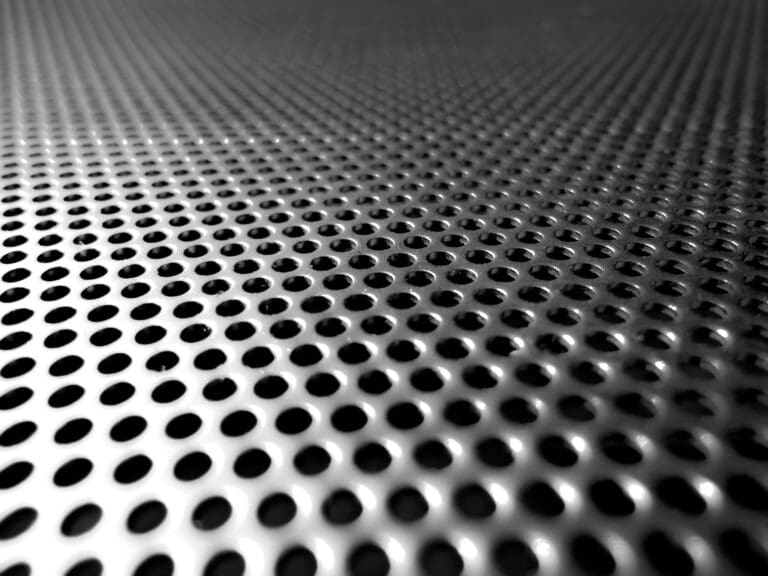
While perforated metals often deliver visual appeal, their role in structural performance is equally critical. Perforated sheets are used in filtration, ventilation, acoustics, weight reduction, and architectural screening—functions that demand uniformity and strength. If the perforation process is even slightly inaccurate, several problems arise: misaligned holes weaken the sheet and create stress points; inconsistent hole sizing alters airflow and acoustic performance; and panels that must align with other elements develop costly fitment issues.
By engineering perforation equipment and tooling for repeatability and accuracy, we ensure each sheet performs as intended—whether supporting a building facade, protecting machinery, or filtering particles in industrial systems. Precision preserves the balance between function, aesthetics, and durability.
Applications Where Integrity Is Critical
- AerospaceIn aerospace applications, weight, strength, and safety converge. Components must fit together perfectly and withstand extreme stresses such as high speeds, temperature fluctuations, and vibration. Laser-cut brackets, housings, and perforated ventilation systems rely on exact machining to ensure structural integrity is never compromised.
- AutomotiveFrom perforated heat shields to laser-cut chassis components, accuracy is vital in the automotive industry. Inaccurate machining can lead to misalignment, excessive wear, or structural failures that jeopardize safety. Precision ensures vehicles remain durable, efficient, and safe over time.
- ConstructionPerforated metal panels and laser-cut structural elements are common in modern architecture and infrastructure. Whether a decorative screen on a high-rise or a load-bearing support in a bridge, accuracy ensures elements maintain both aesthetic appeal and functional strength. Poor precision can cause project delays, safety hazards, and failures that affect entire structures.
How Accuracy Reduces Costs and Waste
There is a direct economic dimension to accuracy and structural integrity in machining: cost efficiency. Precision fabrication reduces the likelihood of errors, meaning less material waste and fewer reworks. Accurate nesting of laser-cut parts maximizes material usage; consistent perforation patterns mean fewer defective sheets; and components that fit together seamlessly shorten assembly time and reduce labor. For customers, this translates into stronger, more reliable products at a lower overall cost.
Accuracy also supports predictable schedules. When parts arrive within tolerance, downstream processes—bending, welding, coating, and installation—proceed without interruption. Eliminating rework prevents bottlenecks on the shop floor and at the jobsite, helping teams meet deadlines and avoid penalty costs.
Quality Control: Safeguarding Integrity
Maintaining accuracy requires more than advanced machines. It requires rigorous quality control. We employ regular machine calibration, digital measurement systems, and in-process inspections to ensure every part meets strict specifications. By detecting and correcting deviations early, we prevent minor errors from becoming structural risks.
Quality assurance builds customer confidence. When you specify a tolerance, material, or pattern, you receive exactly what you ordered—part after part, run after run. This reliability is the essence of accuracy and structural integrity in machining and the reason our customers return to us for critical applications.
Our Commitment to Precision
With decades of experience in perforated metals and precision laser cutting, we deliver products engineered for strength and consistency. Our investment in technology, tooling, and process control allows us to hold tight tolerances, maintain repeatability, and provide documentation when required. Clients in aerospace, automotive, construction, and other demanding industries trust us to supply components that perform as expected, under pressure, and over time.
For us, accuracy is not optional—it is a promise. From quoting and design support through machining and inspection, we align processes to protect structural integrity at every step. The result is simple: parts that fit, perform, and last.
Never Compromise Precision, Strength, and Safety!
In machining, accuracy and structural integrity are two sides of the same coin. Without precision, strength and safety are compromised; without structural integrity, precision loses its value. Together, they form the foundation of reliable performance in every industry that depends on metal fabrication.
Laser cutting and perforated metals show how accuracy safeguards strength—by ensuring components fit, distribute loads evenly, and resist failure. From aerospace to construction, the stakes are too high to accept anything less. We are proud to operate at the intersection of precision and performance. For every cut, every hole, and every project, we deliver the accuracy that protects structural integrity—helping customers build safer, stronger, and more efficient products.