Roy Mfg Knowledge Base
When selecting materials for your construction or manufacturing project, the choice of steel can significantly impact both the process and the final product. As a leading perforated metal manufacturer in Portland, Oregon, Roy Manufacturing frequently works with various types of steel, including Hot Rolled Steel (HRS), Cold Rolled Steel (CRS), and Pickled and Oiled (P&O) Steel. Each type of steel has distinct characteristics, making it more suitable for certain applications. However, in many cases, these types of steel can be interchangeable depending on the specific requirements of your project. In this article, we explore the differences between HRS, CRS, and P&O Steel and provide guidance on how to choose the right material for your needs.
Hot Rolled Steel (HRS)
Hot-rolled steel is produced by heating steel slabs to a high temperature, typically above 1,700°F, which is above the recrystallization temperature of steel. This process makes the steel easier to shape and form. The steel is then rolled at high temperatures, resulting in a product that is less precise in terms of dimensions and surface finish compared to cold-rolled steel. HRS is typically characterized by its rough, scaly surface, which is a result of the oxidation process during rolling.
Characteristics of HRS
- Surface Finish: HRS has a rough and scaled surface, which can be removed if needed by processes like pickling and oiling (see P&O below.)
- Tolerances: HRS typically has looser tolerances compared to CRS, meaning there is more variability in the thickness and shape.
- Mechanical Properties: HRS has good strength and ductility, but the properties can vary due to the uneven cooling process.
- Cost: Generally, HRS is less expensive than CRS because of the simpler manufacturing process.
Applications of HRS
HRS is often used in applications where precise dimensions and surface quality are not critical. Common uses include:
- Construction beams and structural components
- Railroad tracks
- Agricultural equipment
- Automobile frames
- Heavy-duty machinery
HRS is ideal for situations where material strength and durability are more important than surface finish and dimensional accuracy.
Cold Rolled Steel (CRS)
Cold Rolled Steel is produced by further processing HRS. After the initial hot rolling process, the steel is cooled and then rolled again at room temperature. This additional rolling process improves the steel’s surface finish, tightens dimensional tolerances, and enhances mechanical properties. CRS typically has a smoother, more polished surface and is more uniform in thickness and shape.
Characteristics of CRS
- Surface Finish: CRS has a smooth and polished surface, making it ideal for applications where aesthetics are important.
- Tolerances: CRS has tighter tolerances, meaning more precise dimensions and a more consistent thickness.
- Mechanical Properties: CRS is stronger and harder than HRS due to the work-hardening process during cold rolling. It also has higher tensile strength and a better surface finish.
- Cost: CRS is more expensive than HRS because of the additional processing steps involved.
Applications of CRS
CRS is commonly used in applications where appearance, surface finish, and dimensional accuracy are critical. Examples include:
- Automotive panels and parts
- Home appliances
- Furniture and fixtures
- Precision machinery components
- Architectural panels
CRS is often chosen for applications that require a smooth, polished finish and exacting tolerances.
Pickled and Oiled Steel (P&O)
Pickled and Oiled Steel is a variation of hot-rolled steel. After the hot rolling process, the steel is “pickled” in a bath of acid to remove the scale and oxide that forms on the surface during the hot rolling process. After pickling, the steel is coated with a thin layer of oil to prevent rusting. This process results in a cleaner, smoother surface compared to untreated hot rolled steel while retaining the benefits of HRS.
Characteristics of P&O Steel
- Surface Finish: P&O steel’s surface is smoother than standard HRS’s but not as smooth as CRS’s. The pickling process removes surface impurities, while the oiling provides some corrosion resistance.
- Tolerances: The tolerances are similar to those of HRS, meaning they are not as tight as those for CRS.
- Mechanical Properties: P&O steel retains the strength and ductility of HRS but with an improved surface condition.
- Cost: P&O steel is generally more expensive than standard HRS but less expensive than CRS.
Applications of P&O Steel
P&O steel is often used in applications where the material will be painted, coated, or otherwise finished and where the surface condition is important but not as critical as in CRS applications. Examples include:
- Automotive frames and chassis
- Tubular components
- Agricultural equipment
- Welding applications
- Storage tanks and containers
P&O steel is a good choice when a cleaner surface is required, but the exacting surface quality of CRS is not necessary.
When Can These Steels Be Interchangeable?
While HRS, CRS, and P&O steel have different properties and applications, they can be interchangeable in certain scenarios depending on the project’s specific requirements. Here are a few considerations to help determine when these materials can be substituted for one another:
1. Surface Finish Requirements: If the final product does not require a smooth or polished surface, HRS or P&O steel can be a cost-effective alternative to CRS. For example, if the steel will be painted, coated, or otherwise finished, P&O steel could be a good substitute for CRS.
2. Dimensional Tolerances: If precise dimensions are not critical to the application, HRS or P&O steel could be used in place of CRS. Conversely, if the project requires exacting tolerances and a smooth surface, CRS would be the better choice.
3. Mechanical Properties: In applications where strength and ductility are more important than surface finish or precise dimensions, HRS may be the best option. However, if higher strength and hardness are required, CRS might be necessary.
4. Cost Considerations: Budget is often a significant factor in material selection. If the project can tolerate looser tolerances and a less refined surface finish, HRS or P&O steel may offer cost savings over CRS. For example, in large-scale construction projects where material costs can quickly add up, choosing HRS over CRS could result in substantial savings without sacrificing the project’s integrity.
Choose Roy for your HRS, CRS, and pickled and oiled steel needs.
Understanding the differences between HRS, CRS, and P&O steel is crucial in selecting the right material for your project. Each type of steel has its own set of characteristics that make it suitable for specific applications, but in many cases, these materials can be interchangeable depending on the project’s needs. By carefully considering the surface finish, dimensional tolerances, mechanical properties, and budget, you can choose the steel that best meets your requirements.
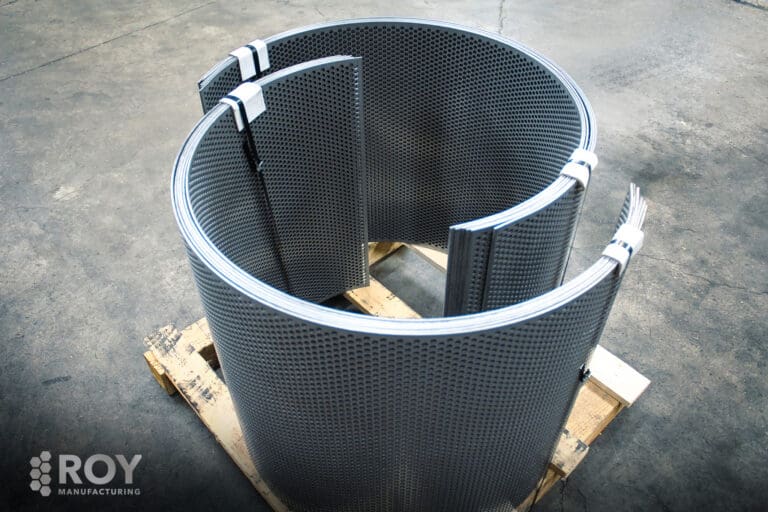
At Roy Manufacturing, we specialize in providing high-quality perforated metal products made from various types of steel, including HRS, CRS, and P&O. Our team is here to help you navigate the complexities of material selection and ensure that you get the best product for your application. Contact us today to discuss your project and learn more about how we can assist you in making the right choice.