Profile Laser Knowledge Base
Whether you’re prototyping a new product or scaling up for full-scale production, your choice of fabrication method impacts your bottom line, your lead times, and the quality of your finished product. The choice often comes down to laser cutting or waterjet – but how do you make that choice?
While both technologies are pillars of modern fabrication, they serve very different masters. One offers the lightning-fast precision of fiber optics, while the other provides the raw, versatile power of high-pressure erosion. That’s why at Profile Laser, we don’t believe in a one-size-fits-all approach. Our Portland-based facility is equipped with world-class TRUMPF Fiber Lasers and the ability to work with waterjet systems, so we can always make an unbiased recommendation for the technology that’s the best fit for your project and your bottom line.
What Are Things to Consider When Choosing Laser Cutting or Waterjet?
When choosing between laser cutting and waterjet for your project, the decision typically comes down to three factors: material type, material thickness, and edge requirements. Fiber laser cutting is the go-to for thin to medium-gauge materials and intricate designs. On the other hand, waterjet cutting is ideal for thicker projects and heat-sensitive materials and composites.
Precision Engineering: When to Choose Fiber Laser Cutting
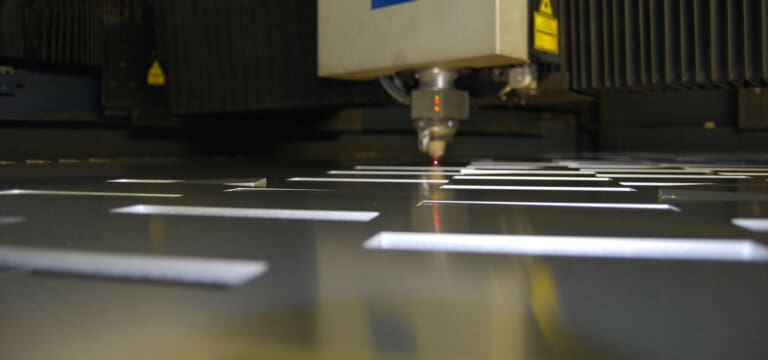
Fiber laser cutting is the gold standard for projects where speed and high-tolerance precision are non-negotiable. Our state-of-the-art TRUMPF fiber lasers utilize a concentrated beam of light to melt or vaporize material with surgical accuracy.
The Speed Advantage: Fiber lasers are significantly faster than waterjets when processing thin to medium-gauge metals (typically up to 0.375”). For high-volume production runs, this speed translates to lower costs per part and faster turnaround times.
Superior Tolerances: If your design features intricate patterns, small holes, or requires a tolerance of ±0.002”, laser cutting is your solution. The narrow kerf (the width of the cut) allows complex geometry that other methods can’t replicate.
Etching and Engraving: Unlike waterjet systems, our laser can perform dual roles. We can cut your part, and then use that same machine for laser etching and engraving to add serial numbers, logos, or assembly marks directly to the surface.
Cold Cutting Versatility: The Power of Waterjet Technology
While laser cutting excels at speed, waterjet cutting is a fabrication powerhouse. Using an OMAX 60120 waterjet system, we use ultra-high-pressure water infused with garnet abrasives to erode material away.
No Heat-Affected Zone (HAZ): The most significant advantage of waterjet over laser cutting is that it’s a cold process. Laser cutting generates heat, which can sometimes cause slight warping or alter the tempered properties of certain metals. Waterjet cutting eliminates thermal stress entirely. This makes it the only choice for heat-sensitive materials or aerospace-grade components that demand zero metallurgical change.
Unmatched Material Thickness: While lasers struggle as materials get thicker, waterjets thrive. They can cut through thick plates of stainless steel, aluminum, and even non-conductive materials like stone or thick plastics that laser beams can’t penetrate.
Versatility Across Substrates: Waterjet technology isn’t just for metal. If your project involves a mix of materials like laminates, composites, or rubber, the waterjet can handle all of them without risking delamination or toxic fumes.
Critical Comparison: Laser Cutting vs. Waterjet at a Glance
When evaluating your project, consider these primary factors:
- Material Thickness: For thin sheet metal (under 1/2″), laser cutting is usually more cost-effective. For thick plate (1″ and above), waterjet is the superior method.
- Edge Quality: Lasers produce a very clean, finished edge. Waterjets provide a smooth, satin-like finish but may require a quick de-burring for a perfectly polished look.
- Project Timeline: If you need thousands of parts by next week, the rapid-fire speed of a fiber laser is hard to beat.
Make a Strategic Laser Cutting or Water Jet Choice with Profile Laser
Choosing between laser cutting or waterjet doesn’t have to be a headache. At Profile Laser, we have the expertise and capabilities to provide unbiased advice based on your specific CAD requirements.
- Rapid Quoting & Turnaround: We know that time is money. That’s why we provide same-day quotes and a standard lead time of only five days for in-stock materials.
- End-to-End Service: Our expertise goes beyond the cut. From 2D CAD design assistance to post-production services like shearing, forming, and de-burring, we mange the entire fabrication process.
Frequently Asked Questions
Which process is more cost-effective for high-volume projects?
Generally, fiber laser cutting is more cost-effective than waterjet for high-volume production of sheet metal (under 0.5”). Because lasers cut at significantly higher speeds than waterjets, the machine time per part is lower, translating to a lower unit price for you.
Will laser cutting damage my material?
Laser cutting is a thermal process. That means it creates a small Heat-Affected Zone (HAZ) along the cut edge. For most industrial applications, this is negligible. However, if you’re working with aerospace-grade materials or parts that require secondary machining (where a hardened edge would break a drill bit), waterjet cutting is the better solution.
Can I get my parts engraved or etched during the cutting process?
If you choose fiber laser cutting, yes! Our TRUMPF lasers can be programmed to instantly switch from a cut to an etch setting. This allows us to add part numbers, assembly instructions, or branding directly to your parts in a single setup. Waterjets do not have this capability.
Take the Guesswork Out of the Fabrication Process
Whether you’re an architect designing custom metal screens or an industrial engineer sourcing precision components, Profile Laser has the technology and the expertise to deliver. Our team is here to take the guesswork out of the fabrication process by helping you choose the most efficient path from CAD to completion. Contact us today for a same-day quote.