Profile Laser Knowledge Base
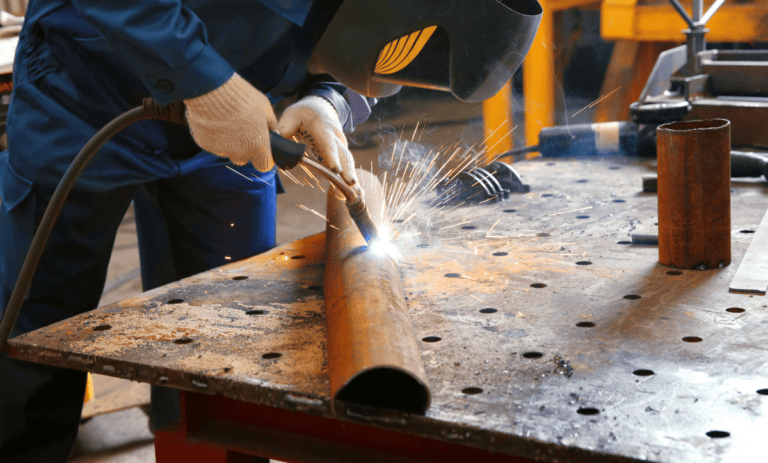
Laser cutting and welding work together to turn raw materials into precise, durable components. The processes are often used jointly in industries like manufacturing and construction to improve part fit, reduce rework, and streamline production. Keep reading to see if it makes sense for your metal fabrication project.
How Do Laser Cutting and Welding Work Together?
Laser cutting and welding work together by combining precise material cutting with strong, reliable metal joining. Laser cutting produces precisely sized components with consistent edges, and welding joins those components into finished assemblies. Fabricators can leverage both processes to improve fit, reduce prep time, minimize material waste, and produce high-quality metal parts more efficiently.
What Role Does Laser Cutting Play in Metal Fabrication?
Unlike traditional cutting methods that rely on physical contact, laser cutting removes material through focused heat. Its concentrated beam of light follows digital designs to create precise, intricate patterns, tight corners, slots, and holes with minimal mechanical force on the workpiece. This gives laser cutting several advantages for metal fabrication projects.
- High precision: Accurate cutting helps components meet exact design specifications and fit together properly.
- Consistent results: Computer-controlled equipment produces repeatable parts across production runs.
- Complex designs: Lasers can create intricate geometries, detailed cutouts, and specialized features.
- Reduced material waste: Strategic part nesting helps manufacturers maximize sheet metal usage.
- Efficient production: Automated cutting reduces manual processing and supports faster workflows.
In our experience, these benefits are especially valuable when manufacturers need to weld multiple laser-cut components into a large assembly.
How Does Precision Laser Cutting Improve Welding Quality?
A strong weld depends on the accuracy and condition of each component. Precision laser cutting helps fabricators create precise parts that fit together correctly.
Accurate Parts Create Better Weld Fit-Up
Weld fit-up is how well two components fit together before a welder joins them. Poor fit-up leads to inconsistent gaps, alignment problems, and extra preparation work.
Laser cutting helps eliminate these issues by producing parts with consistent dimensions. When components fit as intended, welders can maintain predictable joint conditions and spend less time making adjustments.
Clean Cutting Edges Reduce Preparation Work
Laser cutting produces smooth, precise edges that need less finishing than conventional cutting methods. However, material thickness, cutting parameters, and assist gases all affect the edge quality. Properly cut components may need less grinding or edge correction, but fabricators still have to remove contaminants, inspect the joint, and prepare bevels before welding.
Consistent Dimensions Support Repeatable Welding
Manufacturers often need hundreds or even thousands of identical components. Even small dimensional differences in these large production runs can complicate assembly and welding.
Laser cutting provides consistent part geometry, so welders can maintain reliable positioning and joint alignment throughout production. This consistency from laser cutting also supports welding fixtures and automated welding systems.
What Types of Welding Work With Laser-Cut Metal Parts?
Manufacturers can combine laser-cut components with several welding methods. The best approach always depends on your project’s specific material, thickness, joint design, production volume, and performance requirements.
MIG Welding for Efficient Metal Fabrication
More commonly known as gas metal arc welding, metal inert gas (MIG) welding uses a continuously fed wire electrode to join metal components. We’ve found that manufacturers often choose this process for steel and aluminum fabrication because it supports efficient production and works well with many joint configurations.
TIG Welding for Detailed Metal Assemblies
Tungsten inert gas (TIG) welding uses a nonconsumable tungsten electrode to create controlled welds. Fabricators often choose this process for applications that demand precise heat control, a clean weld appearance, or thin materials.
Laser Welding for High-Precision Applications
Laser welding uses focused laser energy to fuse materials together. Unlike laser cutting, which separates material, laser welding creates a permanent joint.
Laser welding offers high processing speeds, narrow welds, and relatively low heat input. However, it also demands careful joint preparation and precise alignment. Laser-cut parts are ideal for laser welding because their consistent dimensions support the tight fit-up requirements of the joining process.
How Can Laser Cutting and Welding Reduce Metal Fabrication Costs?
Combining precision cutting with effective welding creates a more efficient manufacturing process, eliminating extra steps and reducing costs.
- Less manual adjustment: Accurately cut parts need fewer corrections during assembly.
- Reduced rework: Better joint alignment helps manufacturers avoid fit-up problems and welding defects.
- Improved material utilization: Efficient laser cutting layouts lead to less scrap material.
- Faster assembly: Consistent components simplify positioning, fixturing, and joining.
- More predictable production: Repeatable cutting and welding processes help manufacturers accurately plan labor and equipment requirements.
Let’s look at a manufacturer producing metal equipment enclosures as an example. Laser cutting creates the panels, mounting holes, and ventilation openings with consistent dimensions. Welding then joins the components into a rigid structure. When the panels align correctly from the start, the manufacturer has fewer fitting adjustments to make, which improves assembly efficiency and lowers total fabrication costs.
How Does Design for Manufacturability Improve Laser Cutting and Welding?
Design for manufacturability (DFM) helps engineers design components that manufacturers can produce efficiently. When a project needs both laser cutting and welding, designers need to consider how each process affects the other. That starts by reviewing several important design factors before production begins.
Material Thickness and Selection
Different metals respond differently to laser cutting and welding. That means carbon steel, stainless steel, and aluminum each have unique thermal properties and fabrication requirements.
Material thickness also affects cutting speeds, edge preparation, welding methods, and heat input. Selecting an appropriate material and thickness early in the design process can prevent manufacturing complications later.
Joint Design and Welding Access
Welders need to be able to easily reach the areas that need to be joined, or welding becomes complicated and increases production time. Thoughtful laser-cut designs that incorporate tabs, slots, and locating features can help with this. We also recommend designing with weld clearance, joint strength, and potential heat effects in mind.
Heat Distortion and Dimensional Tolerances
Both laser cutting and welding introduce heat to the metal. Welding in particular creates additional thermal stresses that can cause components to expand, contract, or distort. Engineers can manage these effects through optimal joint design, welding sequences, fixturing, and tolerance planning.
Which Industries Benefit From Laser Cutting and Welding?
Laser cutting and welding support a wide range of industries that depend on accurate, durable metal components.
- Industrial equipment manufacturing: Equipment housings, machine guards, brackets, frames, and structural assemblies.
- Data centers: Server rack components, equipment enclosures, mounting systems, and cable management assemblies.
- Construction: Architectural metal components, support brackets, and custom-fabricated assemblies.
- Transportation: Vehicle brackets, equipment mounts, and specialized metal components.
- Electronics: Metal housings, chassis, and precision mounting components.
What Is the Typical Laser Cutting and Welding Process?
Every project has its own specific requirements, but manufacturers generally follow a structured workflow for laser cutting and welding.
- Review the design: Engineers evaluate drawings, dimensions, materials, tolerances, and welding requirements.
- Prepare the cutting files: Programmers create machine instructions and optimize part layouts to reduce material waste.
- Laser cut the components: Precision equipment cuts the required shapes, openings, and features.
- Inspect and prepare the parts: Fabricators verify dimensions, remove contaminants, and complete any necessary edge preparation.
- Position and secure components: Fixtures, clamps, and locating features help maintain proper alignment.
- Complete the welding: Welders join components using the appropriate welding process and procedures.
- Inspect the finished assembly: Quality checks verify dimensions, weld integrity, and applicable project specifications.
Why Should Manufacturers Coordinate Maufacturing Processes Early?
A common fabrication mistake we see is when customers treat laser cutting and welding as completely separate operations. In reality, the two processes go hand in hand, and the best results come from evaluating the entire manufacturing workflow before production begins.
For example, a complex bracket may require several welded components. If the designer overlooks welding access or heat distortion, the fabrication team may need to modify the parts or adjust the assembly process.
The better approach is to bring your fabricator in early in the design stage to discuss material selection, part geometry, tolerances, and downstream fabrication. In our experience, those conversations help identify opportunities to simplify assembly, improve part fit, and reduce avoidable production costs.
Streamline Your Metal Fabrication Project at Profile Laser
Whether a metal fabrication project involves individual brackets, complex enclosures, or parts for welded assemblies, laser cutting lays the foundation for efficient manufacturing. At Profile Laser, we help manufacturers produce custom laser-cut metal components with the accuracy and consistency their projects demand.
If your project calls for precision parts for welding, our Portland, Oregon-based team can help you evaluate cutting requirements, material considerations, and design details to meet your specifications. Contact us today for a same-day quote.
Frequently Asked Questions
What is the difference between laser cutting and laser welding?
Laser cutting uses a concentrated laser beam to separate metal into precise shapes and components. Laser welding uses focused laser energy to join metal pieces together. Both processes offer high precision, but they serve different purposes in metal fabrication.
Why is laser cutting important before welding?
Precision laser cutting creates accurately sized components with consistent edges, which helps improve alignment and fit-up before welding. Parts that fit properly need fewer manual adjustments, simplify assembly, and help welders produce more consistent joints. It can also reduce rework and improve overall manufacturing efficiency.
Can you weld metal parts after laser cutting?
Yes. Manufacturers routinely weld laser-cut steel, stainless steel, aluminum, and other compatible metals. Laser cutting produces precise components that manufacturers can join using MIG, TIG, laser welding, or other methods.
Does laser cutting reduce welding costs?
Laser cutting can help reduce welding costs by improving component accuracy and minimizing preparation work. When parts fit together correctly, welders spend less time correcting alignment issues or modifying components. Consistent laser-cut parts also help streamline assembly and reduce certain types of rework, especially during larger production runs.
How does precision laser cutting improve welded assemblies?
Precision laser cutting improves welded assemblies by creating components with consistent dimensions and accurate joint geometry. Better part fit-up helps manufacturers maintain alignment, reduce adjustments, and simplify welding preparation. This all results in more efficient production and helps manufacturers achieve consistent quality across multiple assemblies.