Profile Laser Knowledge Base
When you need precision-cut components, the technology behind the laser makes all the difference in speed, material compatibility, efficiency, and the quality of the finished part. While CO2 lasers are ideal for organic materials, fiber lasers have become a pillar of metal fabrication. Both technologies have their time and place, and understanding what those are is how engineers, manufacturers, and purchasing teams choose the right technology for their project.
What Is the Difference Between Fiber Lasers and CO2 Lasers?
Fiber lasers use a solid-state laser source to deliver a beam through optical fiber, while CO2 lasers use a gas mixture to generate their beam. Fiber lasers also use a shorter wavelength that metals absorb more effectively, which increases cutting speed and efficiency. CO2 lasers operate more slowly, but are useful for many non-metal materials and specialized applications.
How Do Fiber Lasers Work for Metal Cutting?
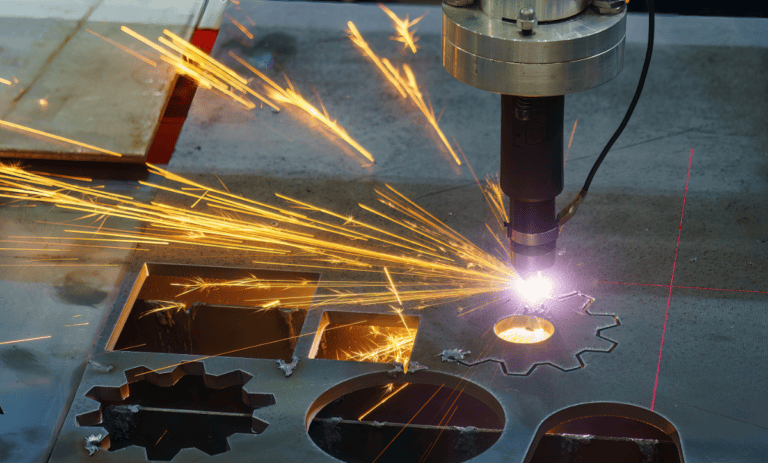
A fiber laser generates light through solid-state diodes and sends that energy through fiber optics to the cutting head. The system then focuses an intense beam onto a small area of the workpiece, where it melts or vaporizes the material along the programmed cutting path.
One of the biggest differences between fiber and CO2 technology is the wavelength. Fiber lasers typically operate at approximately 1 micrometer, compared with roughly 10 micrometers for CO2 lasers. That shorter fiber wavelength is absorbed more effectively by metals like steel and aluminum, leading to fast, precise cuts.
How Do CO2 Lasers Work?
A CO2 laser generates its beam using a carbon dioxide gas mixture. The system then uses a mirrored optical path to direct the beam to the workpiece.
CO2 technology has served manufacturers for decades and still has advantages for certain applications, especially those with nonmetallic materials like acrylic, wood, textiles, or plastic. That versatility means it isn’t a question of have fiber lasers replaced CO2 lasers; it’s which technology matches the material and the job.
Why Is Fiber Laser Technology Better for Metal Cutting?
Fiber technology brings several advantages to metal fabrication.
Faster Cutting Speeds
The fiber laser’s shorter wavelength and concentrated beam mean the material can efficiently absorb the laser’s energy. That, in turn, means fiber lasers can reach substantially higher cutting speeds than comparable CO2 systems. Those faster speeds help shorten production cycles and increase throughput, which is invaluable when a project moves from prototype to repeat production.
Better Performance With Reflective Metals
Reflective metals like aluminum, brass, and copper create challenges for traditional CO2 laser systems because they reflect more of the laser energy instead of efficiently absorbing it. Fiber lasers, however, effectively handle these materials because the shorter fiber wavelength is absorbed more readily. This makes fiber laser cutting the go-to choice when a project calls for something other than standard carbon steel.
Greater Efficiency
Compared with traditional CO2 laser systems, fiber lasers generally require less electricity to produce the cutting energy needed for the workpiece. Fiber lasers also have exponentially lower maintenance demands than their CO2 counterparts. For customers, that efficiency often leads to competitive part costs, especially across large production runs.
Which Materials Can Fiber Lasers Cut?
Fiber lasers are ideal for a wide range of metals, and at Profile Laser, we work with all of them.
- Stainless steel
- Carbon steel
- Mild steel
- Galvanized steel
- Aluminum
- Copper
- Brass
- Bronze
- Titanium
- Silicon bronze
- COR-TEN®
Are CO2 Lasers Better for Any Materials?
Yes. CO2 lasers bring several advantages to nonmetallic materials. Their wavelength works effectively with materials like wood, acrylic, textiles, and certain plastics.
This is why manufacturers can’t treat fiber lasers vs. CO2 lasers as a contest with one winner. Fiber technology offers significant advantages for many metal-cutting jobs, and CO2 technology is ideal for applications with materials that respond better to the longer wavelength.
How Do Fiber and CO2 Technology Compare for Precision and Edge Quality?
Both technologies are capable of producing highly accurate components. However, the ideal choice depends on the material and thickness.
Fiber lasers deliver excellent part quality in thin sheet metal, and modern fiber systems can maintain consistent cut quality in thicker material. Likewise, CO2 systems have a long-earned reputation for extremely smooth cut edges, particularly on some thicker materials.
Keep in mind that you can’t rely on laser type alone for precision. Precise parts also depend on accurate CAD files, appropriate cutting parameters, material condition, assist gas, part geometry, and secondary fabrication requirements.
Do Fiber Lasers Lower the Cost of Metal Fabrication?
Fiber lasers can help lower the cost per part thanks to their faster processing and lower operating requirements. Manufacturers can cut more components in a given timeframe, especially when processing sheet metal. Just keep in mind that actual project savings vary based on material, thickness, part complexity, quantity, nesting efficiency, and finishing requirements.
When Should You Choose Fiber Laser Cutting?
Fiber laser cutting is a great choice when your project calls for precision metal components, efficient production, or repeatable results across multiple parts. We recommend fiber laser cutting for:
- Precision sheet metal components
- Complex profiles and detailed geometries
- Stainless steel, carbon steel, or aluminum
- Reflective metals like brass or copper
- Prototype parts that might turn into larger production runs
- Projects where fast processing can improve lead times
- Repeat components that require consistent dimensions
In our experience, the best manufacturing process depends on the complete part specification. We’ve found that there are some cases where punching or waterjet cutting may be a better solution than laser cutting. With multiple fabrication capabilities under one roof, our team can objectively evaluate your project instead of forcing every component through the same process.
Find Precision Laser Cutting at Profile Laser
When comparing fiber lasers and CO2 lasers, the technology matters – but your finished part matters more. At Profile Laser, our team is here to help you determine the right process for your project.
Our equipment includes TRUMPF 3030 and TRUMPF 2030 fiber lasers, along with CO2 lasers for etching and engraving. At our Portland, Oregon-based facility, we provide laser cutting, punching, shearing, forming, watejet cutting, drilling, polishing, rolling, and other fabrication capabilities for customers nationwide. Contact us today for a same-day quote and see how we can deliver accurate, high-quality components on your schedule.
Frequently Asked Questions
What is the main difference between fiber lasers and CO2 lasers?
Fiber lasers use a solid-state laser source and transmit the beam through optical fiber, while CO2 lasers generate a beam from a gas mixture. Fiber lasers use a shorter wavelength that metals absorb efficiently, making them especially effective for cutting steel, stainless steel, aluminum, brass, copper, and other metals.
Are fiber lasers better than CO2 lasers for cutting metal?
Fiber lasers typically provide faster cutting speeds, strong energy efficiency, and excellent performance with many common fabrication metals. However, the best choice still depends on your project’s material type, thickness, part geometry, tolerances, production volume, and edge-quality requirements.
When are CO2 lasers a better choice?
CO2 lasers are useful for many nonmetallic materials, including acrylic, wood, textiles, and certain plastics. Their suitability depends on the specific application, which is why manufacturers should choose laser technology according to material and project requirements instead of assuming one system works best for every job.
Do fiber lasers cut faster than CO2 lasers?
Fiber lasers can cut many thin and medium-gauge metals faster than comparable CO2 systems because metals absorb the fiber laser’s shorter wavelength efficiently. Actual cutting speed varies according to laser power, material, thickness, assist gas, geometry, and machine settings.
Can fiber lasers cut reflective metals?
Yes. Fiber lasers work particularly well with reflective metals like aluminum, brass, and copper. These materials absorb the shorter fiber laser wavelength more effectively than the longer wavelength produced by traditional CO2 laser systems.