Profile Laser Knowledge Base
Some projects, like decorative facades and medical devices, call for thin gauge metal. These projects often leave little to no room for error, which can be a challenge with traditional thermal cutting methods. Laser cutting, on the other hand, avoids the struggle with heat management, making it a great option to reduce warping in thin gauge metal.
At Profile Laser, we know that maintaining a material’s flatness is just as important as executing an accurate cut. By using advanced fiber laser technology, we provide our clients with a solution that leaves both the metal’s structural integrity and aesthetic perfectly intact.
How Does Fiber Laser Cutting Reduce Warping in Thin Metal?
Fiber laser cutting reduces warping in thin gauge metal by using a highly concentrated, small-diameter beam that creates a minimal Heat Affected Zone (HAZ). Unlike CO2 lasers or plasma cutting, the fiber laser’s rapid processing speed and narrow kerf limit the amount of thermal energy that’s absorbed by the surrounding material, preventing internal stresses that cause heat distortion and deformation.
The Science of Heat Management in Metal Fabrication
HAZ is the primary culprit in metal warping. When metal is subjected to high temperatures during the cutting process, the molecular structure of the surrounding area expands. As it cools, it contracts at a different rate than the rest of the sheet, which creates internal tension. In thin gauge materials, this tension manifests as warping or rippling.
Our team has found that fiber lasers excel where others fail in this regard. The fiber laser operates at a wavelength that’s more readily absorbed by metal, which creates a much faster cold start to the cut. This speed is essential – the faster the laser moves, the less time heat has to migrate into the body of the part. Fiber laser cutting’s localized heat application ensures that
Advantages of Fiber Laser for Thin-Gauge Components
We’ve found that fiber laser technology offers several distinct advantages to reduce warping in thin gauge metal:
- Minimized Thermal Distortion: The beam is so concentrated that the energy is used almost entirely for vaporization at the cut line. This leaves the adjacent material cool to the touch.
- High-Speed Processing: Fiber lasers move significantly faster than CO2 lasers on gauges thinner than ¼ inch, which is the sweet spot for avoiding heat soak.
- Narrow Kerf Width: A thinner cut means less material is removed and less energy is required. This further protects the stability of the thin sheet of metal.
- Clean Edge Quality: High-speed fiber cutting typically eliminates the need for secondary deburring, which can sometimes bring its own mechanical stresses to a thin part.
Overcoming Challenges with Reflective Thin-Gauge Metals
Materials like copper, brass, and certain aluminum alloys are highly reflective and thermally conductive, which makes them notoriously difficult to cut without warping. Standard cutting methods require higher power settings to overcome the reflectivity of these metals. This, in turn, dumps massive amounts of heat into the part.
At Profile Laser, we use fiber lasers specifically because they easily handle reflective materials. The fiber beam’s shorter wavelength is less likely to reflect back into the optics and more likely to instantly pierce the material. This efficiency lets us maintain tight tolerances and reduce warping in thin gauge metal that would otherwise be prone to severe potato-chipping during the fabrication process.
Our Commitment to High-Quality Precision Results
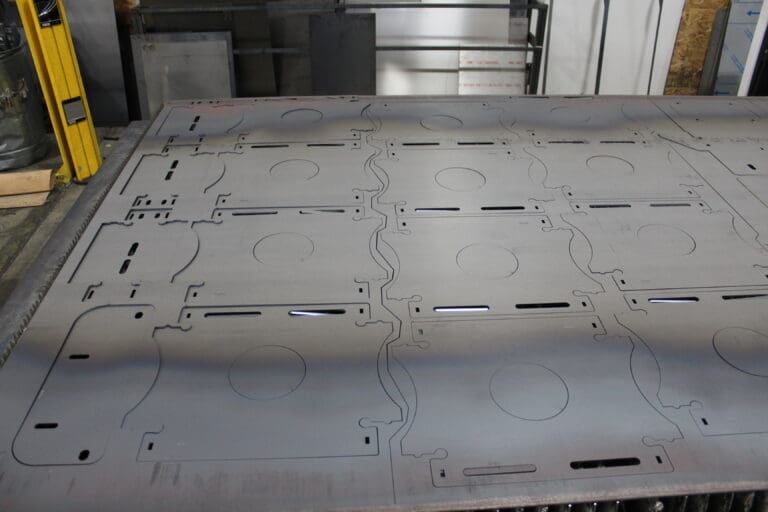
We stay up to date with the latest technology so we can consistently deliver the highest-quality laser-cut products that meet your exact specifications. Our team uses advanced CAD technology to ensure every nest is optimized for both thermal distribution and material yield. By strategically placing tabs and sequencing cuts, we further mitigate any potential for movement during the production run.
Whether you’re developing a prototype for a medical device or need a high-volume run of decorative architectural panels, our Portland-based facility is well-equipped to handle the most delicate thin-gauge metal requirements. Regardless of your order volume, we ensure that the quality and flatness of your parts remain consistent.
Frequently Asked Questions
What is the thinnest metal you can laser cut without warping?
While we can cut materials as thin as 0.005 inches, we frequently work with common thin gauge materials between 24-gauge and 10-gauge. Our fiber laser technology ensures these materials stay flat even with complex designs.
Does fiber laser cutting work on aluminum and copper?
Yes. Fiber lasers are ideal for reflective metals like aluminum, brass, and copper. The beam wavelength allows for efficient absorption, which prevents the heat buildup that typically causes warping in these conductive materials.
What is your typical turnaround time for laser-cut parts?
We offer a standard quick turnarounds. Depending on material availability and design complexity, we can often provide three-day turnarounds or even same-day production for urgent needs.
Ready to Reduce Warping in Your Thin Gauge Metal Projects?
If you’re struggling with warped parts or inconsistent quality from traditional fabrication methods, we can help. Our team at Profile Laser is ready to optimize your designs for the best possible results. Contact us today for a same-day quote.